
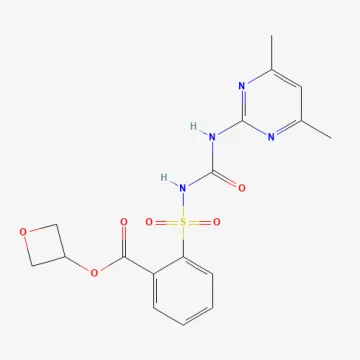
Oxasulfuron
Description
Mode of action
Oxasulfuron belongs to the sulfonylurea chemical class. It is a systemic herbicide that is rapidly absorbed by both the leaves and the root system of weeds, followed by translocation throughout the plant's vascular system.
The primary mode of action is the inhibition of the acetolactate synthase (ALS) enzyme. This enzyme is essential for the biosynthesis of branched-chain amino acids, such as valine, leucine, and isoleucine, which are critical for plant development.
Disruption of amino acid synthesis leads to a rapid cessation of cell division in the meristematic tissues. Weeds stop competing with the crop shortly after application, long before visible symptoms appear on the foliage.
Visual symptoms usually appear gradually, starting with chlorosis of the growth points, followed by necrosis. The plant typically dies completely within two to three weeks, depending on environmental conditions.
The high selectivity of oxasulfuron ensures it targets susceptible weed species while leaving the protected crop unharmed, provided the specified application regulations are strictly followed.
What it targets
This herbicide is specifically designed to control a broad spectrum of broad-leaved weeds in various agricultural crops. It is highly effective even against species that show resistance to other herbicide classes.
Key weed species targeted by oxasulfuron include:
- Common lambsquarters (Chenopodium album)
- Redroot pigweed (Amaranthus retroflexus)
- Smartweed species (Polygonum spp.)
- Shepherd's purse (Capsella bursa-pastoris)
- Hemp-nettle (Galeopsis tetrahit)
Oxasulfuron allows for effective field cleaning during critical vegetative stages, preventing weeds from exhausting soil nutrients and water resources. It is particularly effective against early-stage weed growth.
By controlling competitive weeds, the product supports the health and yield potential of the crop. It is valued for its ability to provide long-lasting protection against various broad-leaved competitors.
Application success depends on treating the weeds at the right developmental stage, typically when they are in the 2- to 4-leaf stage of growth, which ensures optimal absorption and lethality.
Rates and timing
Application rates for oxasulfuron depend on the weed spectrum, the density of the infestation, and the growth stage of the crop. Regulations are established to ensure maximum biological effect with minimal chemical load.
Precision in dosing is critical. Deviating from the recommended dosage can lead to decreased efficacy or potential phytotoxicity to the crop. Always refer to the specific label for accurate mixing instructions.
Treatment timing should coincide with the active growth phase of the weeds. Application should be performed in dry, calm weather to avoid drift and ensure sufficient chemical uptake by the target plants.
The use of surfactants or adjuvants is often recommended to improve the penetration of the herbicide through the leaf cuticle. This practice significantly enhances effectiveness under challenging environmental conditions.
The temperature range is a significant factor. Optimal biological activity is achieved when air temperatures are between +15°C and +25°C, coupled with adequate soil moisture for active weed metabolism.
Restrictions
Oxasulfuron exhibits a certain level of persistence in the soil. Therefore, crop rotation plans must account for the potential impact of residual active substances on sensitive follow-up crops.
Drift prevention is essential. Spraying should be avoided during high winds to prevent contact with adjacent sensitive crops. Proper equipment calibration and the use of drift-reduction nozzles are mandatory.
Operators must wear appropriate personal protective equipment (PPE) during handling and application. Strict adherence to safety protocols is required to protect the operator and the environment.
Environmental constraints include strict prohibition of use near aquatic ecosystems. The substance can be toxic to aquatic organisms, and contamination of water sources must be strictly avoided.
To prevent the development of weed resistance, it is recommended to rotate oxasulfuron with herbicides from different chemical groups that possess a different mechanism of action.
Status in the European Union
Not approved in the EU
- CAS number
- 144651-06-9
- Category (EU)
- HB - Herbicide
- Approved from
- 01.07.2003
- Approval until
- 08.08.2018
- ADI
- 0.013 mg/kg bw/day
- ARfD
- Not appl.
- AOEL
- 0.013 mg/kg bw/day
EU status is for reference only and does not replace national registration in your country.