
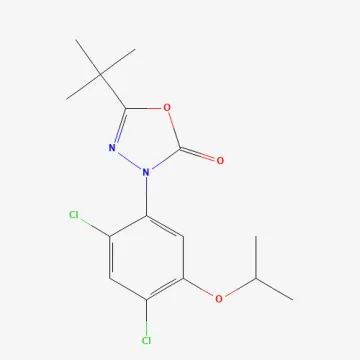
Oxadiazon
Description
Mode of action
Oxadiazon is a member of the oxadiazole chemical class and functions as a selective contact herbicide. It primarily inhibits photosynthesis by blocking the electron transport system in the chloroplasts of sensitive plant species.
The mode of action involves the rapid destruction of chlorophyll synthesis, leading to the necrosis of weed tissues as soon as the germinating shoots contact the treated soil surface.
The substance lacks systemic translocation within the plant, which contributes to its high selectivity, as crop plants can typically metabolize the chemical without experiencing significant injury.
Due to its low water solubility, oxadiazon remains localized in the upper soil layer, establishing a persistent chemical barrier that inhibits the germination of weed seeds for an extended period.
Environmental conditions, particularly soil moisture, play a vital role in efficacy, as the germinating seeds must be exposed to the herbicide-treated soil particles to be controlled.
What it targets
Oxadiazon is highly effective against a wide array of broadleaf weeds and certain grasses when applied at the germination stage.
Major targets include species such as pigweed, common purslane, lambsquarters, and various species of knotweed and nightshade.
It is widely recognized for its ability to suppress tough annual weeds that compete with vegetable, ornamental, and industrial crops during the early growth stages.
The compound is not intended for the control of established perennial weeds, as it relies on contact with developing sprouts rather than systemic uptake through mature foliage.
- Amaranthus retroflexus
- Portulaca oleracea
- Chenopodium album
- Polygonum spp.
- Solanum nigrum
Rates and timing
The application rates of oxadiazon depend significantly on the soil type, with lighter soils requiring lower concentrations than heavy, high-organic-matter soils.
Ideally, application should occur pre-emergence, immediately following soil preparation, to ensure the herbicide forms a uniform film over the seedbed.
Avoid any deep cultivation after application, as disturbing the soil surface will break the herbicide barrier and reduce the effectiveness of weed suppression.
The equipment must be calibrated precisely to ensure even distribution across the entire treated area, preventing striping or missed patches.
In tank mixtures, growers should ensure compatibility with other agrochemicals to avoid physical separation or chemical deactivation of the active ingredient.
Restrictions
Operators must adhere strictly to safety protocols, utilizing appropriate personal protective equipment (PPE) to prevent skin contact and inhalation during handling.
The herbicide is toxic to aquatic life; therefore, buffer zones must be maintained near water bodies to prevent runoff and contamination.
Do not apply the product once crop emergence has begun in crops where post-emergence application is not permitted, to prevent potential phytotoxicity.
Spray drift control is essential; applications should be avoided during windy conditions to protect sensitive off-target vegetation.
Review the rotational crop restrictions on the product label to ensure that residues in the soil do not adversely affect the subsequent planting cycle.
Status in the European Union
Not approved in the EU
- CAS number
- 19666-30-9
- Category (EU)
- HB - Herbicide
- Approved from
- 01.01.2009
- Approval until
- 31.12.2018
- ADI
- 0.0036 mg/kg bw/day
- ARfD
- 0.12 mg/kg bw
- AOEL
- 0.05 mg/kg bw/day
EU status is for reference only and does not replace national registration in your country.