
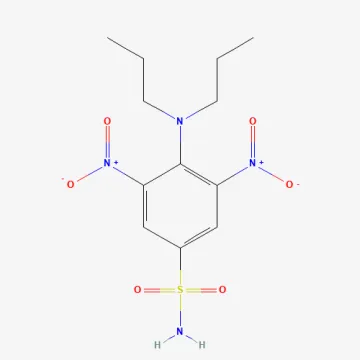
Oryzalin
Description
Mode of action
Oryzalin is a dinitroaniline herbicide that acts as a selective pre-emergence agent, primarily inhibiting the early stages of weed development.
The core mechanism of action involves the inhibition of microtubule assembly during mitosis, which effectively stops cell division in root and shoot meristems.
Because it is applied to the soil, it prevents the development of weed seeds before they can establish a root system, thus preventing competition with the crop.
The molecule is relatively stable in the soil, allowing for a long residual effect that suppresses weed emergence over an extended period of time.
It is not translocated within the plant, which makes it safe for established crops when applied correctly to the soil surface without direct foliage contact.
What it targets
The target spectrum of oryzalin includes a wide range of annual grass weeds and certain small-seeded broadleaf species that germinate from seeds.
Common controlled weeds include barnyardgrass, annual bluegrass, foxtails, and various species of pigweed and lambsquarters.
It is primarily utilized in horticultural settings, including orchards, vineyards, and nurseries, to manage weed populations in the tree or vine rows.
By preventing weed seed germination, it provides a cleaner growing environment and reduces the need for frequent mechanical cultivation.
It is important to note that oryzalin does not control established perennial weeds growing from rhizomes or taproots, requiring complementary management strategies.
Rates and timing
Application rates are determined by soil texture; heavier clay soils require higher doses to account for greater herbicide adsorption.
Timing is crucial: the product must be applied to clean soil surfaces before the target weeds germinate to achieve maximum efficacy.
Incorporation via light irrigation or mechanical harrowing into the top 2-5 cm of soil is often recommended to activate the herbicide.
The residual activity provides protection throughout the season, but effectiveness can be influenced by heavy rainfall or extreme soil moisture conditions.
Sprayers must be calibrated to ensure uniform distribution, as an uneven application can lead to patchy weed control or unnecessary chemical loading.
Restrictions
Crop rotation restrictions must be observed, as residues of dinitroaniline herbicides can potentially affect sensitive subsequent crops.
Direct spray contact with foliage or green stems of the target crop should be avoided to prevent potential injury or stunted growth.
Strict personal protective equipment (PPE) protocols must be followed during mixing and application to minimize human exposure.
As oryzalin is toxic to aquatic life, precautions must be taken to prevent runoff into surface waters, drainage ditches, or irrigation systems.
Storage should be in a cool, dry, well-ventilated area, kept strictly in the original container away from unauthorized personnel, food, and animal feed.
Status in the European Union
Not approved in the EU
- CAS number
- 19044-88-3
- Category (EU)
- HB - Herbicide
- Approved from
- 01.06.2011
- Approval until
- 31.05.2021
- ADI
- 0.05 mg/kg bw/day
- ARfD
- Not appl.
- AOEL
- 0.05 mg/kg bw/day
EU status is for reference only and does not replace national registration in your country.