
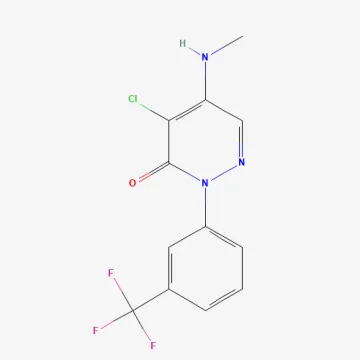
Norflurazon
Description
Mode of action
Norflurazon belongs to the pyridazinone chemical class and is a highly effective systemic herbicide with selective action. Its key feature is the inhibition of photosynthesis during the early stages of plant development.
The substance inhibits the biosynthesis of carotenoids, which perform a protective function for chlorophyll. As a result of the absence of carotenoids, rapid destruction of chlorophyll occurs in weed tissues when exposed to sunlight.
Visually, the effect manifests as pronounced chlorosis (bleaching) of the leaves, after which the plant quickly dies. Since the product is absorbed by the roots, it is most effective when applied to the soil before emergence.
The molecule has a high degree of persistence in the soil profile, which provides long-term protection of crops from subsequent flushes of weeds over an extended period.
This herbicide does not have contact action on emerged vegetation; therefore, it is critical to maintain a clean field before application to achieve maximum results.
What it targets
Norflurazon is primarily used for the control of a broad spectrum of annual grasses and certain broadleaf weeds in agricultural crops.
Among the most sensitive targets are species such as annual bluegrass, foxtail, crabgrass species, and other hard-to-control grasses.
The product also shows efficacy against several common broadleaf weeds that are sensitive to carotenoid inhibitors during the germination phase.
Application of the herbicide helps reduce competitive pressure on the main crop during its most critical period of establishment and early growth.
- Grass weed control
- Suppression of broadleaf seedlings
- Long-lasting soil residual activity
Rates and timing
Norflurazon application rates depend strictly on soil type, specifically organic matter content and soil texture. On sandy or light soils, dosages should be minimal to prevent phytotoxicity.
On heavy soils with high humus content, higher application rates are required because soil particles actively adsorb the active ingredient, reducing its availability to weeds.
Application is carried out mainly by spraying the soil surface before planting or immediately after planting, but prior to crop emergence.
A mandatory condition for product activation is the presence of minimal soil moisture or subsequent irrigation/rainfall, which transports the herbicide into the root zone.
Waiting periods and the number of applications must strictly comply with the regulations specified by the manufacturer for specific agricultural crops.
Restrictions
The main limitation is the high sensitivity of many follow-on crops to norflurazon residues in the soil, which makes standard crop rotations difficult without accounting for the half-life period.
It is strongly discouraged to use the product on soils with very low organic matter, as there is a high risk of the substance leaching into the root zone of the target crop.
When working with this herbicide, it is necessary to use personal protective equipment for skin and respiratory protection, avoiding spray drift onto adjacent crops.
Avoid application on sites with high erosion risk or on fields with a steep slope, as runoff into water bodies or low-lying areas may occur, leading to uneven concentration.
Storage should be in the original packaging in a cool, ventilated place, out of reach of children and pets, and away from sources of open flame.
Status in the European Union
Not approved in the EU
- CAS number
- 27314-13-2
- Category (EU)
- HB - Herbicide
EU status is for reference only and does not replace national registration in your country.