
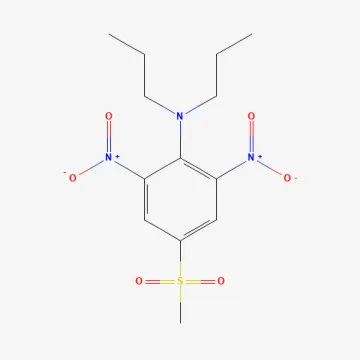
Nitralin
Description
Mode of action
Nitralin belongs to the dinitroaniline chemical class. This selective active ingredient exerts herbicidal activity by inhibiting the process of cell division in the meristematic tissues of plant seedlings.
The mechanism of action involves disrupting the assembly of microtubules in cells, which is critical for the formation of the mitotic spindle. As a result, plants cease root and shoot growth immediately after germination.
The substance acts at the soil level; therefore, for maximum effectiveness, it must be uniformly distributed in the top layer of the treated soil. The herbicide is not systemic and must be applied before weed emergence.
A critical aspect is the need to incorporate the product into the soil, as nitralin is subject to photodegradation and volatilization when exposed to direct sunlight. Proper cultivation after application ensures the molecules are anchored within the soil matrix.
Nitralin-based products are characterized by moderate persistence, which allows for the protection of the crop during the initial critical growth phases, preventing competition from weeds.
What it targets
Nitralin is primarily used to control a wide spectrum of annual grass weeds and some broad-leaved weeds.
It is effective against common field pests such as foxtail species, barnyardgrass, large crabgrass, and certain types of lambsquarters.
The product does not have a significant impact on perennial weeds that propagate via rhizomes, which must be considered when planning a crop protection system.
- Green and yellow foxtail
- Barnyardgrass
- Large crabgrass
- Common lambsquarters (at early stages)
The primary goal of application is to create a protective soil "screen" that prevents weed seeds from germinating within agricultural crop fields.
Rates and timing
The timing of nitralin application is strictly tied to the sowing campaign: soil treatment is conducted before sowing the crop or immediately after, but always before emergence.
The application rate depends on the soil type: dosages are reduced on light sandy soils, while maximum allowable rates are applied on heavy loams or soils with high organic matter content.
Quality application requires careful soil preparation: the surface must be leveled and free of large clods to ensure the herbicide screen remains continuous.
After application, immediate mechanical incorporation to a depth of 3–5 cm is mandatory to prevent the loss of the active ingredient.
When using tank mixtures, a compatibility test must be performed, as nitralin may interact chemically with other pesticide components.
Restrictions
Nitralin is not recommended for use on soils with very low organic matter content, as this increases the risk of phytotoxicity to crops.
Personal protective equipment for skin and respiratory protection must be used when handling the product to avoid direct contact with the concentrate.
Crop rotation must be considered: after using high doses of nitralin, certain sensitive crops may be restricted for planting in the following season.
The product is toxic to fish and other aquatic organisms; therefore, it is prohibited to conduct treatments near water bodies or use open water sources to wash equipment.
Storage should be in the original packaging in dry, cool areas, out of reach of children and animals, and separated from food supplies.
Status in the European Union
Not approved in the EU
- CAS number
- 4726-14-1
- Category (EU)
- HB - Herbicide
EU status is for reference only and does not replace national registration in your country.