
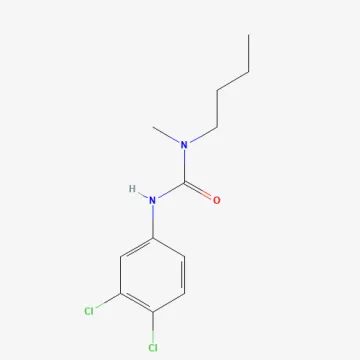
Neburon
Description
Mode of action
Neburon belongs to the chemical class of substituted ureas. In terms of its physiological effect on plants, it acts as a systemic herbicide that is primarily absorbed by the root system of germinating weeds.
The mechanism of action of the substance involves the inhibition of photosynthesis. Neburon blocks electron transport in photosystem II, which leads to a disruption of the energy metabolism within the plant cell.
As a result of photosynthesis arrest, the synthesis of essential organic substances in weeds ceases. This leads to gradual chlorosis, wilting, and subsequent death of the unwanted vegetation.
The substance is characterized by low water solubility, which determines its prolonged persistence in the soil layer. It moves slowly through the soil profile, providing a long-lasting protective effect.
Due to its selectivity, herbicides based on neburon are capable of eliminating weeds in crops that possess the ability to metabolize the active ingredient into non-toxic compounds.
What it targets
Neburon is primarily used for the control of annual broad-leaved and some grassy weeds during their early developmental stages. It is most effective against seeds that are in the germination phase.
The spectrum of action includes a wide range of weed grasses frequently encountered in grain crops and vegetable fields. It prevents the emergence of new shoots over a significant period of time.
The application of the product is most appropriate under conditions of sufficient soil moisture, as its main activity against weed seedlings is manifested in the soil solution.
Neburon is virtually ineffective against perennial weeds that develop from rhizomes or deep-seated bulbs. Its main task is the control of the "second wave" and seedlings emerging from the soil seed bank.
In agronomic practice, it is often used in integrated protection programs where a combination of immediate seedling destruction and the creation of a protective soil barrier is required.
Rates and timing
The application rates of neburon depend on the soil type, its mechanical composition, and the level of field infestation. Higher doses are required on heavy, humus-rich soils due to the partial adsorption of the substance by soil particles.
Application timing is strictly regulated by the growth stages of the crops. Most often, the herbicide is applied before crop emergence or during very early growth phases to avoid crop damage.
An important factor in determining timing is soil moisture. In the absence of precipitation or irrigation, the herbicide's effectiveness may be significantly reduced due to slow dissolution of the active ingredient.
It is recommended to perform treatment using functional spraying equipment that ensures uniform distribution of the product over the soil surface to create a continuous protective screen.
After herbicide application, it is necessary to consider crop rotation restrictions, as residual amounts of neburon in the soil can affect the growth of sensitive crops planted in the following season.
Restrictions
Working with neburon requires strict adherence to personal protection measures. It is necessary to use respirators, gloves, and protective clothing to prevent contact with skin and mucous membranes.
The use of the product is prohibited in water protection zones due to the potential danger to aquatic organisms. Drift of the working solution onto neighboring fields with sensitive crops should also be avoided.
Storage of the product must be in its original packaging in dry, cool warehouse facilities, out of reach of children and animals, and separated from food and animal feed.
After completing operations, it is necessary to thoroughly clean the sprayer according to instructions to prevent equipment contamination and accidental damage to other crops during subsequent treatments.
Before using a specific product, always read the current label and manufacturer's recommendations, as rates and limitations may vary depending on the formulation.
Status in the European Union
Not approved in the EU
- CAS number
- 555-37-3
- Category (EU)
- HB - Herbicide
EU status is for reference only and does not replace national registration in your country.