
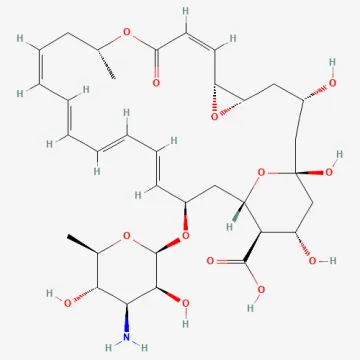
Natamycin
Description
Mode of action
Natamycin (pimaricin) is a macrolide polyene antibiotic produced by soil bacteria of the species Streptomyces natalensis. In agronomy, it is classified as a biological fungicide with potent antimycotic activity.
The mechanism of action of this substance is based on its ability to bind to sterols in fungal cell membranes, primarily ergosterol. This interaction leads to irreversible disruption of membrane integrity and loss of its selective permeability.
As a result, the internal environment of the fungal cell becomes vulnerable, causing leakage of vital components. This process rapidly inhibits mycelial growth and prevents the reproduction of pathogenic spores.
A key feature is the high specificity of natamycin, as it effectively targets a wide range of fungal pathogens without affecting plant cells, which lack ergosterol.
The use of natamycin helps reduce the pesticide load on the soil, as the substance is highly biodegradable under natural conditions, minimizing the accumulation of toxic residues in crops.
What it targets
The primary application of natamycin is the control of mold fungi and yeast-like organisms that affect agricultural products during storage and transportation.
The agent effectively inhibits the growth of pathogens such as Aspergillus, Penicillium, Fusarium, and various Candida species, which are known to cause rotting in fruits and vegetables.
In field conditions, natamycin and its derivatives can be used as components of biological control systems against surface infections on vegetable and fruit crops.
Using natamycin-based products significantly lowers the risk of mycotoxin formation on produce, which is crucial for meeting food quality and safety standards.
The formulation is also applied for seed treatment to suppress infectious inoculum transmitted from the seed surface into the soil.
Rates and timing
The application rates of natamycin depend on the specific formulation and the type of crop being treated. The substance is most commonly used in low-concentration solutions for spraying or dipping.
Application timing is determined by the development stage of the pathogen and storage conditions. When treating produce post-harvest, the procedure is carried out in humidity-controlled rooms to ensure maximum contact between the agent and the surface.
For seed treatment, it is essential to follow the manufacturer's regulations to avoid negative effects on germination energy, despite the biological nature of the compound.
Intervals between applications during the growing season should be at least 10–14 days, due to the half-life of the active component under solar ultraviolet radiation.
During the storage of treated produce, maintaining an appropriate temperature regime is important, as it enhances the fungicidal activity of natamycin and extends its protective effect until sale.
Restrictions
A major limitation is the instability of natamycin in direct sunlight (UV radiation), which limits its broad application in open fields during daylight hours.
The efficacy of the product may decrease significantly at extreme pH values. The optimal range for stable activity is between 5.0 and 7.0 units.
Safety precautions include the use of personal protective equipment when handling concentrates, although natamycin is considered to have low toxicity to warm-blooded animals.
Mixing natamycin with strong oxidizing agents should be avoided, as this leads to rapid inactivation of the active ingredient and loss of the fungicide's protective properties.
- Store in a cool, dark place.
- Avoid exposure of the working solution to direct sunlight.
- Observe pre-harvest intervals according to the product regulations.
Status in the European Union
Pending
- CAS number
- 7681-93-8
- Category (EU)
- OT - Other treatment
EU status is for reference only and does not replace national registration in your country.