
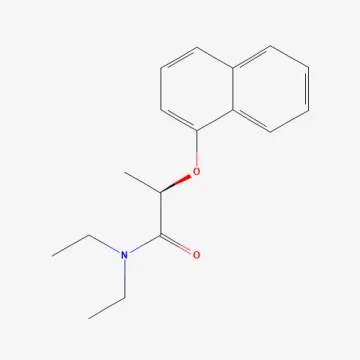
Napropamide-M
Description
Mode of action
Napropamide-M belongs to the amide chemical class. It is a selective systemic herbicide that is primarily absorbed by the root system of germinating weeds.
The active ingredient blocks cell division in the meristematic tissues of the seedling. As a result, growth processes are disrupted, leading to the death of weeds before they emerge from the soil surface.
The product exhibits high mobility in the soil profile in the presence of moisture, which allows it to effectively reach the germination zone of weed seeds.
An important feature of Napropamide-M is its ability to suppress the second "wave" of weeds for an extended period by creating a protective "screen" in the topsoil layer.
The substance is characterized by high selectivity regarding the crops for which it is registered, causing no depressive effect when application regulations are followed.
What it targets
Napropamide-M effectively controls a wide range of annual grasses and certain broad-leaved weeds.
The main targets include difficult-to-control species such as barnyard grass, annual bluegrass, foxtail, as well as some species of goosefoot and knotweed.
- Barnyard grass (Echinochloa crus-galli)
- Foxtail (Setaria spp.)
- Annual bluegrass (Poa annua)
- Common lambsquarters (Chenopodium album)
The herbicide suppresses weed development during the critical early growth period of crop plants.
The efficacy of the preparation depends directly on the cleanliness of the field and the quality of soil preparation before application.
Rates and timing
Application rates vary depending on soil type, humus content, and the weed species composition in a specific area.
The product is applied exclusively before crop emergence, typically during pre-sowing cultivation or immediately after sowing but before the first seedlings appear.
When applied before cultivation, incorporation into the soil at a depth of 2–5 cm is recommended to ensure optimal contact of the active ingredient with the moist soil layer.
To achieve maximum effect, the soil must be well prepared, free of large clods that hinder the uniform distribution of the herbicidal screen.
In case of lack of rainfall or low soil moisture after application, the efficacy of the product may decrease, therefore irrigation is recommended.
Restrictions
Inter-row cultivation is not recommended after applying the product, as it destroys the established herbicidal "screen" and reduces control efficiency.
When planning crop rotation, the residual effect of the product must be considered, as some crops may be sensitive to residues in the soil.
When working with the herbicide, personal protective equipment for skin, eyes, and respiratory organs must be used to eliminate the risk of poisoning.
Application of the product in water protection zones and in close proximity to drinking water sources is prohibited due to the risk of substance migration.
Preparation of working solutions should be carried out on specially equipped sites in compliance with all environmental safety standards.
Status in the European Union
Pending
- CAS number
- 41643-35-0
- Category (EU)
- HB - Herbicide
EU status is for reference only and does not replace national registration in your country.