
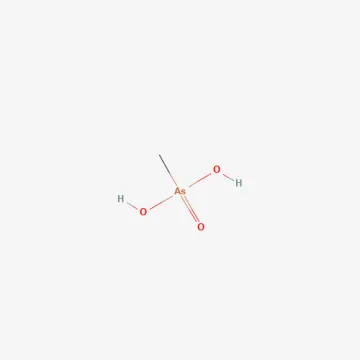
MSMA
Description
Mode of action
MSMA (monosodium methanearsonate) is an organoarsenical herbicide widely used for post-emergence weed control. It belongs to a chemical group that interacts with the enzymatic systems of target plants.
The mechanism of action involves the inhibition of metabolic processes essential for plant survival. Upon application, the compound is absorbed by the foliage and translocated through the plant tissues to effectively disrupt photosynthesis.
The herbicidal effect manifests as chlorosis and subsequent necrosis of the leaves and stems. Depending on the species and environmental conditions, complete plant control is typically achieved within one to two weeks.
MSMA acts as a systemic herbicide. Its effectiveness is highly dependent on environmental factors, specifically temperature and humidity, which influence the rate of translocation within the weeds.
Despite being an organic arsenical, it exhibits lower acute toxicity compared to inorganic arsenic compounds. Nevertheless, it must be handled with care to prevent environmental contamination and human exposure.
What it targets
MSMA is primarily used to control a variety of annual and perennial grasses, including crabgrass, dallisgrass, barnyardgrass, and johnsongrass. It is also effective against several sedge species.
Common applications include cotton fields, fruit orchards, and managed turf areas such as golf courses. In cotton production, it serves as a critical post-emergence tool for grass suppression.
The use of MSMA on vegetable or cereal crops is limited due to potential phytotoxicity. It is essential to ensure that the cultivated species has sufficient natural tolerance before application.
It is often used as a resistance management tool, providing an alternative mode of action where weeds have developed resistance to glyphosate or other common herbicide classes.
The control spectrum is best utilized when treating weeds in the young seedling stage, specifically when they have 2–4 true leaves.
Rates and timing
Application rates for MSMA are determined by the target weed species and the growth stage of the crop. Proper calibration of spraying equipment is necessary to ensure uniform distribution.
Timing is critical to avoid crop injury. Applications are usually restricted to specific growth phases, and spraying during reproductive stages of the crop should generally be avoided.
Sequential applications may be necessary for heavy weed infestations. When repeat applications are performed, adequate intervals must be maintained to prevent plant stress and soil accumulation.
The use of surfactants or adjuvants is highly recommended to improve leaf surface wetting and herbicide absorption, especially in species with waxy cuticles.
Temperature significantly impacts performance; application is most effective under warm, sunny conditions between +20°C and +30°C, as this maximizes weed metabolic uptake.
Restrictions
The primary environmental restriction is to avoid application near water sources, as arsenic compounds can persist and negatively impact aquatic ecosystems and soil health.
Many jurisdictions have strict regulations or bans on MSMA usage due to concerns about arsenic accumulation in soils and the potential for leaching into groundwater.
To mitigate the risk of weed resistance, MSMA should be rotated with herbicides of different chemical classes. Continuous use of a single mode of action will inevitably lead to selection for resistant weed biotypes.
Personal Protective Equipment (PPE), including gloves, respirators, and protective clothing, is mandatory during mixing and application to prevent inhalation and dermal exposure.
Adherence to pre-harvest intervals (PHI) is vital to ensure that the final agricultural product meets safety standards and contains no unacceptable levels of arsenic residues.
Status in the European Union
Not approved in the EU
- CAS number
- 124-58-3
- Category (EU)
- HB - Herbicide
EU status is for reference only and does not replace national registration in your country.