
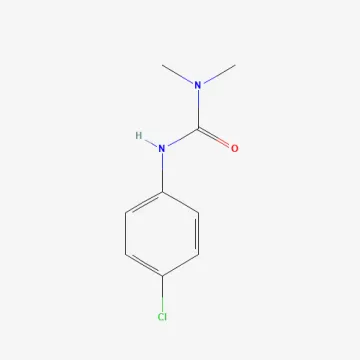
Monuron
Description
Mode of action
Monuron belongs to the chemical class of substituted ureas (phenylureas). It is a systemic active ingredient that exhibits significant herbicidal activity when applied to the soil.
The mechanism of action is based on the inhibition of photosynthesis in susceptible plants. The substance blocks electron transport in photosystem II, leading to a disruption of the energy metabolism in weed cells.
Absorbed mainly by the root system, monuron is translocated via the xylem (acropetally) to the above-ground parts of the weed. The accumulation of the preparation in the leaves causes chlorosis and subsequent tissue necrosis.
The process of weed death begins with the appearance of stress symptoms, which progress to complete leaf necrosis. The efficacy of the preparation depends directly on soil moisture and active sap flow in the plants.
Unlike contact products, monuron has a prolonged action, providing crop protection in the early stages of vegetation by creating a protective screen in the soil layer.
What it targets
The preparation effectively controls a wide spectrum of annual broad-leaved and some grass weeds germinating from seeds. It is especially active against species sensitive to photosynthesis inhibitors.
- Redroot pigweed
- Common lambsquarters
- Shepherd's purse
- Field mustard
- Common chickweed
The economic value of monuron lies in its potential use for vegetation control on industrial sites and non-agricultural lands.
The preparation demonstrates high biological efficacy in destroying young weed vegetation, preventing the appearance of new "waves" of seedlings over a long period.
Application against perennial weeds has limited success, as the substance is more effective against germinating seeds and young seedlings than against the developed root system of perennials.
Rates and timing
Application rates of the preparation vary depending on the soil type: lower dosages are required on light sandy soils, while rates are increased on heavy loams to achieve a stable result.
Application is carried out mainly during the pre-emergence period. An important condition for efficacy is the availability of sufficient soil moisture to dissolve and move the active ingredient into the root zone.
The timing of application is determined by the weed development stage and the intended crop. It is not allowed for use on crops under stress or at critical temperatures that reduce metabolic processes.
When treating industrial areas, rates may be higher than in agricultural use, allowing for a total vegetation control effect (non-selective herbicide).
An agronomist must strictly adhere to the regulations, as exceeding the application rate can lead to the accumulation of residual amounts of the substance and negatively affect subsequent crops in the rotation.
Restrictions
The main limitation is the pronounced soil persistence. Monuron can remain in the soil for a long time, creating a risk of carry-over for sensitive agricultural crops.
The use of the preparation is prohibited in water protection zones and near water bodies, as the substance is highly mobile and can cause groundwater contamination during heavy rainfall.
When working with monuron, the use of personal protective equipment is mandatory: respirators, gloves, and protective clothing, as the substance can cause skin and mucous membrane irritation.
Drift of the working solution onto neighboring agricultural crops must be prevented, as even micro-doses of the preparation can cause phytotoxicity in cultivated plants.
After using the machinery, thorough cleaning of the sprayer tanks must be performed according to the regulations to avoid damage to sensitive crops during subsequent applications with other products.
Status in the European Union
Not approved in the EU
- CAS number
- 150-68-5
- Category (EU)
- HB - Herbicide
EU status is for reference only and does not replace national registration in your country.