

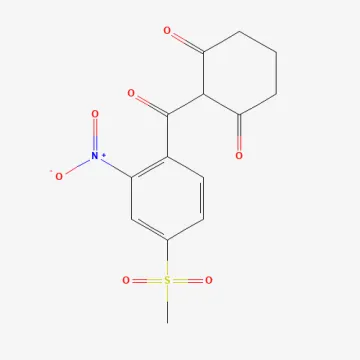
Description
Mode of action
Mesotrione belongs to the chemical class of triketones and acts as a selective systemic herbicide for crop protection.
The primary mechanism of action is the inhibition of the enzyme 4-hydroxyphenylpyruvate dioxygenase (4-HPPD) within plant cells.
By blocking this enzyme, the plant ceases the production of carotenoids, which are essential for protecting chlorophyll from UV degradation.
As carotenoid levels drop, chlorophyll is destroyed by sunlight, causing visible bleaching (chlorosis) followed by plant necrosis.
The substance is rapidly absorbed by both foliage and roots, providing robust control and preventing new weed emergence through soil activity.
What it targets
The main application of mesotrione is in maize (corn) fields, where it targets a wide range of broadleaf and some grass weeds.
Commonly controlled weeds include species of Amaranthus (pigweed), Chenopodium album (lambsquarters), Ambrosia (ragweed), and Solanum nigrum (black nightshade).
It is particularly effective against weed biotypes that have developed resistance to sulfonylureas or triazine-based herbicides.
The product also limits the growth of Abutilon theophrasti (velvetleaf) and various Polygonum species that threaten crop yields.
Due to its residual soil activity, mesotrione provides long-lasting protection against subsequent flushes of germinating weeds.
Rates and timing
Application rates for mesotrione depend on the specific formulation, the developmental stage of the weeds, and the target crop's tolerance.
The standard application timing is during the early vegetative phase of corn, specifically between the 2-leaf and 8-leaf stages.
Using adjuvants or surfactants is highly recommended to improve leaf penetration and coverage, especially on harder-to-control species.
Farmers often tank-mix mesotrione with other herbicides to broaden the spectrum and ensure effectiveness across diverse weed populations.
Strict adherence to the manufacturer's label rates is mandatory to avoid potential crop injury or uneven field performance.
Restrictions
Careful crop rotation planning is necessary, as certain crops may be sensitive to soil residues of mesotrione in the following season.
It is generally advised not to use mesotrione on crops treated with organophosphate insecticides to minimize the risk of plant injury.
Personal Protective Equipment (PPE) including gloves, eye protection, and respirators must be worn during preparation and application.
The product should be stored in original, tightly closed containers in a dry, cool, and secure location away from children and livestock.
Waste management, including empty containers and excess spray solution, must follow local environmental health and safety regulations.
Content graph
Connections · Mesotrione
Most often together:
Marketplace
Products · 88


Desperado, CS (mesotrione, 480 g/L)
Аріста ЛайфСайенс С.А.С., Ногер, Франція
Herbicides
0
0
·
60
No offers
—
Details


ME-STAR 480 SC
Zhejiang Zhongshan Chemical Industry Group Co., Ltd.
Herbicides
0
0
·
58
No offers
—
Details

Mezotrex Ultra R (Mezotrex Ultra R)
Shandong Weifang Rainbow
Herbicides
0
0
·
57
No offers
—
Details

Drammero® 45,7, w.g.
«Дюпон Інтернешнл Оперейшнз Сарл», Швейцарія
Herbicides
0
0
·
56
No offers
—
Details


Farex 105 OD (Farex 105 OD)
QEMETICA Agricultural Solutions Poland S.A.
Herbicides
0
0
·
50
No offers
—
Details


Desperado, CS (mesotrione, 480 g/L)
Аріста ЛайфСайенс С.А.С., Ногер, Франція
Herbicides
0
0
·
34
No offers
—
Details


Desperado, EC (mesotrione, 480 g/L)
Аріста ЛайфСайенс С.А.С., Ногер, Франція
Herbicides
0
0
·
30
No offers
—
Details

MORGAN, KS (mesotrion, 100 g/l +nicosulfuron, 45 g/l)
Agrochemical Factory, LLC
Herbicides
0
0
·
30
No offers
—
Details
