
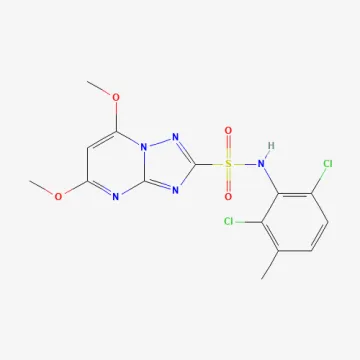
Metosulam
Description
Mode of action
Metosulam belongs to the triazolopyrimidine chemical class. It is a systemic substance that penetrates the plant through leaves and roots, moving rapidly throughout the plant tissues.
The primary mechanism of action involves blocking the acetolactate synthase (ALS) enzyme. Inhibiting this enzyme stops the synthesis of essential amino acids such as leucine, isoleucine, and valine.
As a result of these metabolic disruptions, cell division ceases in the growing points. The first signs of weed suppression become visible within a few days after application.
Complete death of sensitive weed species occurs within 10–15 days, depending on environmental conditions. The plant stops growing, followed by chlorosis and tissue necrosis.
Due to its high selectivity, the substance works effectively in crop fields because the crop plants can quickly metabolize and neutralize the herbicide's effects.
What it targets
This herbicide is designed to control a broad spectrum of broad-leaved weeds. It effectively destroys the most problematic species in cereal and maize crops.
Sensitive targets include weeds such as cleavers, chamomile species, sow thistle, common lambsquarters, pigweed, shepherd's purse, and many others.
The product is highly valued for its effectiveness against cleavers at various developmental stages, including overgrown specimens.
Metosulam actively suppresses cruciferous weeds, which often pose high competition for cultural plants during early vegetation stages.
- Galium aparine (Cleavers)
- Sonchus species (Sow thistle)
- Matricaria inodora (Chamomile)
- Amaranthus retroflexus (Pigweed)
- Capsella bursa-pastoris (Shepherd's purse)
Rates and timing
The application rate depends directly on the weed species composition and their growth stage. It is usually used in tank mixtures to broaden the spectrum of action.
Optimal application timing coincides with the period of active weed growth. For most broad-leaved plants, this corresponds to the 2 to 6 true leaf stage.
In wheat and barley fields, treatment is conducted from the tillering stage to the stem elongation stage. Later application requires strict adherence to technical regulations.
The temperature range for effective work is between +8 and +25 degrees Celsius. Avoid application if there is a risk of night frosts.
It is essential that cultural plants are not under stress. Do not perform treatments if the crop is suffering from drought or excessive soil moisture.
Restrictions
Metosulam possesses some soil activity, which imposes limitations on crop rotation. One must consider the substance's residual period before planting subsequent crops.
When using tank mixtures, it is mandatory to conduct a compatibility test. Avoid mixing with products that might cause phytotoxicity to the main crop.
Operations must be carried out using personal protective equipment for the skin, respiratory system, and eyes. Prevent any runoff into water bodies.
Storage should be in specialized warehouse facilities under temperature conditions that exclude direct sunlight exposure.
Upon reaching the expiration date or in case of container damage, disposal of the product must be conducted according to local environmental laws and regulations.
Status in the European Union
Not approved in the EU
- CAS number
- 139528-85-1
- Category (EU)
- HB - Herbicide
- Approved from
- 01.05.2011
- Approval until
- 30.04.2021
- ADI
- 0.05 mg/kg bw/day
- ARfD
- 0.25 mg/kg bw
- AOEL
- 0.02 mg/kg bw/day
EU status is for reference only and does not replace national registration in your country.