
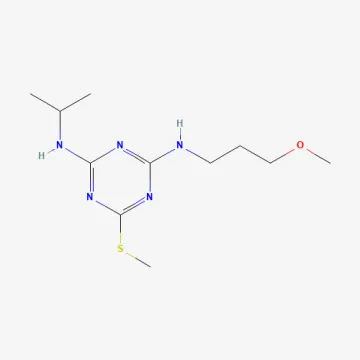
Methoprotryne
Description
Mode of action
Methoprotryne belongs to the symmetric triazine chemical class. It is a systemic active substance that penetrates weeds primarily through the root system, as well as through leaves during early development stages.
The primary mechanism of action involves blocking photosynthesis by inhibiting electron transport in photosystem II. This disrupts the energy metabolism within plant cells.
Once absorbed, the substance translocates via the xylem to the growth points and leaves of the weed. As a result, susceptible plants stop growing, lose turgor, and eventually die from chlorosis and tissue necrosis.
The efficacy of the product directly depends on soil moisture, as it is through the soil solution that the active substance reaches the root system of germinating weeds.
Methoprotryne is characterized by moderate persistence in the soil, providing a long-lasting protective barrier that inhibits the emergence of new weed flushes throughout the growing season.
What it targets
This substance is used to control a wide spectrum of annual broad-leaved and some grass weed species.
The target list includes problematic species such as lamb's quarters, pigweed, knotweed, shepherd's purse, common chickweed, and other weeds sensitive to triazines.
Methoprotryne shows the highest efficiency during the weed germination period, acting on them before or at the moment of the emergence of the first true leaves.
- Lamb's quarters (Chenopodium album)
- Pigweed (Amaranthus spp.)
- Field mustard (Sinapis arvensis)
- Common chickweed (Stellaria media)
- Shepherd's purse (Capsella bursa-pastoris)
For perennial root-sprouting weeds, this herbicide is of low effectiveness, which is why it is often used in tank mixtures or protection programs.
Rates and timing
Application rates for methoprotryne depend on the soil type, organic matter content, and the weed species composition in the field.
In light soils with low organic content, minimum dosages are used to eliminate the risk of phytotoxicity to crop plants.
In heavy clay soils with high humus content, application rates are increased because a portion of the substance is adsorbed by soil particles.
The optimal timing for applying the product is before sowing (with incorporation) or pre-emergence of the crop, which allows for effective field cleaning during early growth stages.
An important factor in choosing the rate is the temperature regime and humidity level: in arid conditions, the effect of the soil barrier may be weakened.
Restrictions
It is not recommended to use methoprotryne on soils with very high sand content, as this may lead to leaching of the product into the root zone of the crop plants.
There are strict restrictions regarding crop rotation: when using high rates of the product, one must consider the risk of residual effects on sensitive crops sown the following year.
When working with the product, it is necessary to strictly observe personal protection measures, excluding contact with skin, mucous membranes, and inhalation.
Products based on methoprotryne should not be used in water protection zones, as they pose a danger to aquatic organisms if they enter open water bodies.
Storage must be carried out in specialized warehouse facilities while maintaining a temperature regime that excludes damage to the herbicide and leakage into the environment.
Status in the European Union
Not approved in the EU
- CAS number
- 841-06-5
- Category (EU)
- HB - Herbicide
EU status is for reference only and does not replace national registration in your country.