
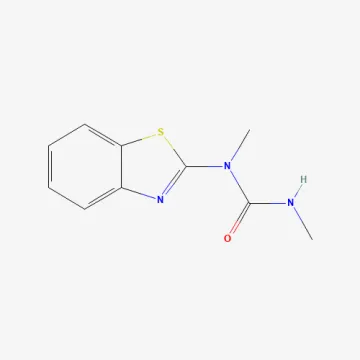
Methabenzthiazuron
Description
Mode of action
Methabenzthiazuron belongs to the chemical class of benzothiazole derivatives. It is a highly effective systemic herbicide capable of penetrating plants through both the root system and the leaf foliage.
The primary mechanism of action involves the inhibition of the photosynthesis process. Upon entering the plant tissues, the compound blocks the Hill reaction, leading to a disruption of electron transport within the chloroplasts.
As a result of the halt in photosynthetic activity, the synthesis of carbohydrates essential for weed growth is stopped. This leads to progressive chlorosis of the leaves, tissue necrosis, and the eventual death of the unwanted vegetation.
The substance exhibits high selectivity. Crop plants, such as wheat, are able to metabolize and neutralize methabenzthiazuron, which ensures the protection of the crop without damaging the cultivated species.
The effectiveness of the product largely depends on the soil moisture levels. Sufficient moisture facilitates active uptake by weed roots, enhancing the herbicidal impact during the early growth stages.
What it targets
Methabenzthiazuron is primarily used for the control of a broad spectrum of annual broad-leaved and certain grass weeds in winter and spring wheat crops.
The product effectively controls common species such as cleavers (Galium aparine), common lambsquarters, various species of knotweed and hemp-nettle, as well as shepherd's purse.
The spectrum of action includes both seedlings in the active growth phase and germinating weed seeds, providing a prolonged protective effect.
To achieve maximum biological efficacy, it is crucial to select the correct weed development stage. Best results are obtained when applying the product at the cotyledon to two-leaf stage of broad-leaved weeds.
The active ingredient also shows activity against certain species of bentgrass, although its effectiveness for controlling perennial root-suckering weeds may be insufficient.
Rates and timing
Application rates for methabenzthiazuron vary depending on soil type, weed infestation intensity, and crop variety, typically ranging from 1.5 to 3.0 kg of active ingredient per hectare.
The optimal application timing for winter crops is during autumn or early spring, when weeds are in the initial stages of development and the crop is in the tillering phase.
For spring applications, it is important to perform the treatment before the stem elongation phase of wheat to avoid physiological stress and yield loss.
The spray volume is usually between 200 and 400 liters per hectare. A key condition is the uniform distribution of the product across the field to avoid unsprayed zones.
The application temperature should be in the range of +10 to +25 degrees Celsius. Using the product under extreme temperatures can reduce its uptake by plants.
Restrictions
There are strict crop rotation restrictions. Due to the moderate persistence of methabenzthiazuron in the soil, potential risks to sensitive crops planted in the following year must be considered.
It is not recommended to apply the herbicide on soils with very high humus content or peat soils, as this may lead to a decrease in the active ingredient concentration and reduced weed control.
Treatment of crops under stress (drought, pest damage, frost) is prohibited, as it reduces the crop's ability to detoxify the product.
To prevent the development of weed resistance, it is recommended to rotate the use of methabenzthiazuron with products that have different modes of action.
Safety precautions include the mandatory use of personal protective equipment when handling the concentrate. Residues and empty packaging must be disposed of in accordance with environmental regulations.
Status in the European Union
Not approved in the EU
- CAS number
- 18691-97-9
- Category (EU)
- HB - Herbicide
EU status is for reference only and does not replace national registration in your country.