
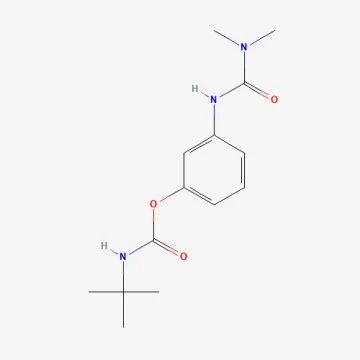
Karbutilate
Description
Mode of action
Karbutilate belongs to the chemical class of urea derivatives and functions as a systemic herbicide. Its primary action is aimed at the complete suppression of physiological processes in unwanted vegetation.
Upon entering the plant through the root system, the active ingredient is actively translocated via the xylem to the growing points. This leads to a rapid disruption of metabolic pathways responsible for the vitality of weeds.
The main mechanism of action involves the inhibition of photosynthesis. The substance blocks the Hill reaction, making the synthesis of essential organic compounds for plant development impossible.
As a result of this systemic impact, gradual wilting, chlorosis, and the subsequent death of both the above-ground biomass and the root system of weed plants occur.
The preparation possesses significant soil activity, which allows it to remain in the upper soil layers for a long time, preventing the re-germination of seeds.
What it targets
This substance is primarily used as a non-selective, total herbicide. It is effective against a wide spectrum of annual and perennial broad-leaved and grass weeds.
Karbutilate demonstrates particular efficacy in controlling difficult-to-eradicate woody and shrub species that infest non-agricultural lands.
The product is successfully used against dangerous species such as quackgrass, field thistle, and other rhizomatous weeds that possess a powerful underground system.
Due to its high soil persistence, it effectively suppresses weed emergence for an extended period following application.
The scope of application includes clearing railway rights-of-way, areas around industrial sites, power lines, and other sites where total vegetation removal is required.
Restrictions
The use of Karbutilate requires strict adherence to safety precautions, as it has no selectivity and can destroy any cultural vegetation.
Application of the preparation is strictly prohibited in water protection zones and near drinking water sources due to its high mobility and persistence in the soil.
It is necessary to avoid spray drift to neighboring agricultural lands, garden plots, or shelterbelts, as even small doses can cause suppression of useful crops.
Work with this substance must be performed using full personal protective equipment for the skin, respiratory tract, and eyes to prevent toxic effects.
- Adhere to regulations regarding waiting periods before allowing people onto the treated area.
- Do not allow the preparation to enter sewage or drainage systems.
- Dispose of containers according to regulations for handling hazardous pesticides.
Status in the European Union
Not approved in the EU
- CAS number
- 4849-32-5
- Category (EU)
- HB - Herbicide
EU status is for reference only and does not replace national registration in your country.