

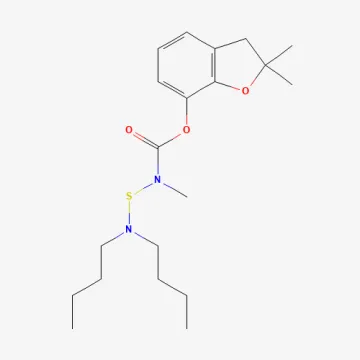
Description
Mode of action
Carbosulfan is a potent insecticide belonging to the carbamate chemical class, widely utilized for its systemic and contact efficacy.
The primary mode of action involves the inhibition of acetylcholinesterase, an enzyme essential for nerve impulse transmission in insects.
Once absorbed by the plant, the active ingredient translocates through the tissue, protecting the developing parts of the crop from infestation.
Carbosulfan also acts as a barrier around seeds in the soil, effectively managing subterranean pests that would otherwise damage emerging seedlings.
In the soil environment, the compound undergoes metabolic transformation into other active carbamates, providing long-lasting control of target organisms.
What it targets
Carbosulfan is specifically designed to control soil-dwelling insects and early-season pests that threaten crop establishment.
It provides a broad spectrum of protection against various coleopteran and dipteran larvae that attack the root zone and stems.
- Wireworms and false wireworms
- Carabid beetle larvae
- Seedcorn maggot
- Aphids and leafhoppers
- Cutworms
The product is frequently used on field crops like corn, sugar beet, potatoes, and various cereals to prevent significant stand loss.
By protecting the seed during the critical germination phase, carbosulfan helps ensure uniform crop development and better yields.
Rates and timing
The primary application method for carbosulfan is as a seed dressing (seed treatment) applied by specialized industrial machinery.
The application rates depend on the specific crop species, the soil type, and the history of pest infestation in the agricultural area.
Correct dosage is critical; growers should follow the label instructions provided by the manufacturer to ensure adequate chemical coverage.
The duration of the protective effect usually ranges from 30 to 50 days, depending on environmental factors such as soil moisture and temperature.
Uniformity in application is essential for consistent protection and to prevent any potential negative impact on seed germination.
Restrictions
Carbosulfan is classified as highly toxic to humans and wildlife, necessitating the use of stringent safety measures and personal protective equipment.
It is strictly prohibited to apply the product in or near water bodies, as it poses a severe threat to fish and other aquatic species.
Measures must be taken to prevent exposure to pollinators; therefore, avoid application where bees might be foraging in the field.
Treated seed must be kept secure, clearly labeled, and kept away from food, animal feed, or any other consumable products.
Adherence to pre-harvest intervals and safe handling protocols is mandatory to protect both the user and the agricultural ecosystem.
Regulatory
Status in the European Union
Not approved in the EU
- CAS number
- 55285-14-8
- Category (EU)
- NE - Nematicide
- ADI
- 0.005 mg/kg bw/day
- ARfD
- 0.005 mg/kg bw
- AOEL
- 0.005 mg/kg bw/day
Hazard classification (CLP)
Acute Tox. 2 - H330Acute Tox. 3 - H301Aquatic Acute 1 - H400Aquatic Chronic 1 - H410Skin Sens. 1 - H317
EU legislation
EU status is for reference only and does not replace national registration in your country.
Content graph
Connections · Carbosulfan
Most often together:
Marketplace
Products · 2

Marshal 25 c.e., Insecticide
Ф.ФМСі, Джексонвіль,США.
Insecticides
0
0
·
46
1 offer
13.1 €per 1 l
Buy