
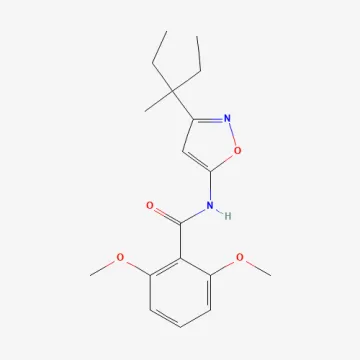
Isoxaben
Description
Mode of action
Isoxaben is a chemical compound belonging to the benzamide class, functioning as a selective pre-emergence herbicide.
The primary mechanism of action involves the inhibition of cellulose biosynthesis within the plant cell walls. This specific action disrupts root and shoot development in germinating weeds.
As a systemic herbicide, it is absorbed by the roots of young seedlings, preventing their emergence and causing early mortality of target weeds.
Isoxaben is characterized by its long-lasting residual activity in the soil, providing a protective barrier against subsequent weed germination cycles.
The herbicide displays high selectivity, allowing crops to grow unharmed while providing effective control over unwanted vegetation in the field.
What it targets
Isoxaben is highly effective against a broad spectrum of broadleaf weeds, making it a valuable tool for integrated pest management programs.
It targets species that are often resistant to other common herbicide classes, providing an alternative for resistance management.
The product is not effective against grasses, which necessitates the use of companion herbicides when a full-spectrum weed control is required.
Common applications include field crops, orchards, vineyards, and landscape maintenance where broadleaf weed infestation is a primary concern.
- Common lambsquarters
- Shepherd's purse
- Common chickweed
- Henbit
- Wild chamomile
Rates and timing
Application rates for isoxaben are determined by soil texture, organic matter content, and the specific weed species present at the site.
Optimal results are achieved when soil moisture is sufficient, as moisture is required for the herbicide to move into the root zone of the target weeds.
Application should occur before weed emergence, typically in the early spring, to maximize the preventive control of early-season weed flushes.
Equipment calibration is crucial to ensure a uniform distribution of the product, as coverage gaps may result in weed breakthrough.
Adhering to the manufacturer's label instructions is essential, as dosage requirements may vary depending on the specific crop and formulation used.
Restrictions
Strict adherence to crop rotation intervals is necessary, as residual amounts of the herbicide in the soil may affect sensitive follow-up crops.
The herbicide should not be applied to sandy or highly porous soils, as there is a risk of leaching into deeper soil layers or groundwater.
Personnel handling isoxaben must wear appropriate personal protective equipment (PPE) to prevent skin contact and inhalation of spray mist.
Avoid spray drift when applying in windy conditions to prevent damage to non-target areas or sensitive vegetation located nearby.
Compatibility checks must be performed before mixing isoxaben with other agrochemicals to avoid chemical degradation or physical instability.
Status in the European Union
Approved in the EU
- CAS number
- 82558-50-7
- Category (EU)
- HB - Herbicide
- Approved from
- 01.06.2011
- Approval until
- 31.01.2027
- ADI
- 0.05 mg/kg bw/day
- ARfD
- Not appl.
- AOEL
- 0.25 mg/kg bw/day
EU status is for reference only and does not replace national registration in your country.