

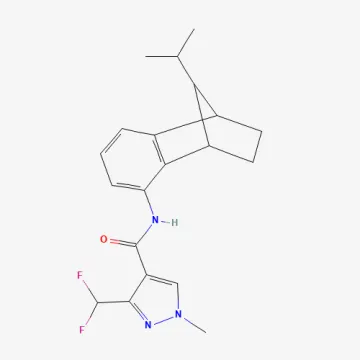
Description
Mode of action
Isopyrazam is a potent member of the pyrazole-carboxamide class, functioning as a Succinate Dehydrogenase Inhibitor (SDHI). It works by disrupting the mitochondrial respiration of fungi, effectively starving the pathogen of energy.
The compound is characterized by high lipophilicity, which allows it to bind strongly to the waxy layer of the leaf cuticle. This ensures superior resistance to rain wash-off and promotes long-lasting protection.
It provides both preventive and curative activity, meaning it can halt the development of fungal mycelium even after the pathogen has established itself within the plant tissue.
Isopyrazam has excellent systemic movement within the plant, which contributes to the protection of new growth and uniform distribution across the foliage.
As an SDHI fungicide, it is highly effective against strains of fungi that have developed resistance to older chemistry, such as strobilurins, making it a vital component in modern resistance management programs.
What it targets
This active substance is primarily used to control a wide range of fungal diseases, specifically targeting powdery mildew, various leaf spots, and rust pathogens in several major crops.
It is widely utilized in the cultivation of cereals, such as wheat and barley, as well as in vegetables and orchard fruit production to maintain health and yield potential.
Isopyrazam is particularly effective against pathogens that reduce the photosynthetic capacity of the plant, thereby protecting the canopy and increasing the final harvest yield.
- Powdery mildew
- Septoria leaf blotch
- Rust diseases
- Rhynchosporium
- Alternaria leaf blight
By preventing premature senescence caused by fungal infections, Isopyrazam allows crops to maximize their grain-filling or fruit-maturation periods.
Rates and timing
Application rates vary depending on the specific product formulation, crop type, and the intensity of the disease pressure observed in the field.
It is recommended to apply Isopyrazam at the early stages of disease development or as a preventative measure during high-risk periods for infection.
The product is compatible with various other classes of fungicides, often used in tank mixtures to broaden the spectrum of protection and manage disease resistance.
Farmers should adhere to the label restrictions regarding the number of applications per season to preserve the efficacy of the active ingredient for future use.
Even application coverage is crucial; using modern spraying technology ensures that the active ingredient is properly distributed across the leaf surface.
Restrictions
Operators must wear appropriate personal protective equipment (PPE), including gloves, respiratory protection, and protective clothing, when handling concentrated forms of Isopyrazam.
The compound can be toxic to aquatic life. Therefore, applications must be avoided near water bodies, and buffer zones must be strictly maintained to protect local ecosystems.
In case of accidental exposure, the affected area should be washed immediately with plenty of water. Medical attention should be sought if irritation or symptoms persist.
Storage must be in original, properly labeled containers, kept in a cool, dry, and locked facility, away from children, animals, and food supplies.
Compliance with the pre-harvest interval (PHI) is mandatory to ensure that the final agricultural produce meets regulatory safety standards for human consumption.
Regulatory
Status in the European Union
Not approved in the EU
- CAS number
- 881685-58-1
- Category (EU)
- FU - Fungicide
- Approved from
- 01.04.2013
- Approval until
- 08.06.2022
- ADI
- 0.03 mg/kg bw/day
- ARfD
- 0.2 mg/kg bw
- AOEL
- 0.05 mg/kg bw/day
EU legislation
EU status is for reference only and does not replace national registration in your country.
Content graph
Connections · Isopyrazam
Most often together:
Marketplace
Products · 8


