
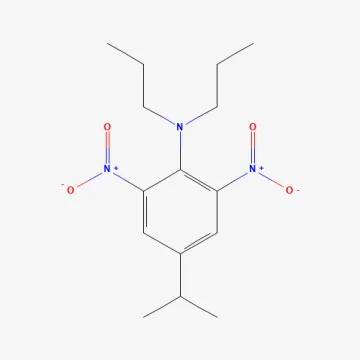
Isopropalin
Description
Mode of action
Isopropalin belongs to the dinitroaniline chemical class and functions as a selective pre-emergence herbicide. It is specifically designed to control weeds before they emerge from the soil surface.
The mode of action involves the inhibition of microtubule assembly within plant cells. By disrupting the formation of these structures, the substance effectively stops mitosis in the meristematic tissues of developing seedlings.
Because it targets the division of cells in roots and shoots, affected seedlings fail to anchor themselves or emerge from the soil. The herbicide is absorbed by the developing radicle and coleoptile, making contact timing critical.
It lacks systemic movement within the plant tissues once the weed has reached maturity. Therefore, it is strictly effective against germinating seeds and is useless against established weeds or perennial species with vegetative organs.
The chemical is moderately persistent in soil, which provides a long-lasting protective barrier. This ensures that seeds germinating in the weeks following application are effectively suppressed by the treated soil layer.
What it targets
Isopropalin is primarily used to manage a range of annual grass weeds and certain broad-leaved weeds that possess small seeds. It is a standard tool in integrated weed management programs for various crops.
The primary spectrum of controlled weeds includes aggressive species that typically emerge during the early vegetative stages of the crop, competing for water, light, and nutrients.
- Barnyardgrass (Echinochloa crus-galli)
- Foxtail species (Setaria spp.)
- Crabgrass (Digitaria spp.)
- Common lambsquarters (Chenopodium album)
The herbicide is particularly effective in high-pressure environments where annual grass infestation is the primary challenge for seedling establishment.
Rates and timing
Application rates are determined by soil texture and organic matter content. Soils with higher clay or humus content require higher doses because the chemical binds more strongly to soil particles.
The product requires mechanical incorporation into the soil to a depth of 2–5 cm immediately after application. This step is essential to prevent degradation by sunlight and loss through volatilization.
The ideal time for application is during pre-planting tillage. Providing a uniform distribution within the soil profile is crucial to achieving consistent weed control across the entire field.
Soil moisture is a vital factor for effectiveness. If the soil is too dry, the herbicide may remain inactive; irrigation or rainfall following the application can significantly improve performance.
Farmers must ensure that crop seeds are placed at the correct depth to avoid contact with the herbicidal layer, preventing potential damage to the developing crop root system.
Restrictions
The main limitation is the total lack of efficacy against weeds that have already emerged. Growers must ensure that all existing vegetation is cleared using tillage or non-selective herbicides before application.
Crop sensitivity must be assessed prior to use. Some modern varieties or specific soil conditions may result in temporary stunting or crop damage if the herbicide is not applied according to the label.
Residual effects on subsequent crops in the rotation must be considered. In certain sensitive cropping systems, long-term persistence in the soil can interfere with the development of susceptible rotational crops.
Safety equipment is mandatory for all personnel handling the product. Dinitroanilines are known to be skin and eye irritants, and inhalation of dust or spray mists must be strictly prevented.
Environmental care is paramount; run-off into aquatic ecosystems must be prevented as the substance is toxic to fish and other aquatic invertebrates. Always follow local environmental regulations for disposal.
Status in the European Union
Not approved in the EU
- CAS number
- 33820-53-0
- Category (EU)
- HB - Herbicide
EU status is for reference only and does not replace national registration in your country.