

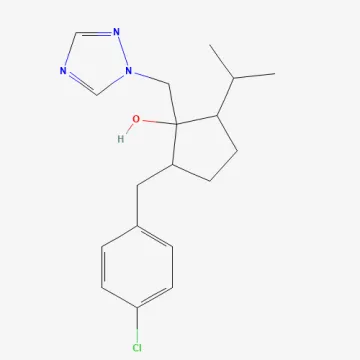
Description
Mode of action
Ipconazole belongs to the triazole chemical class. It is a systemic fungicide that provides both protective and curative properties when used as a seed dressing for agricultural crops.
The mechanism of action involves inhibiting the 14-alpha-demethylase enzyme in the biosynthesis of ergosterol. Ergosterol is a vital component of fungal cell membranes, and its absence prevents the proper growth and division of pathogen cells.
Once applied to the seeds, ipconazole is rapidly absorbed into the embryo and translocated throughout the developing seedling. This ensures a protective barrier that guards the young plant against soil-borne and seed-borne pathogens during the critical early stages of germination.
The high biological efficacy of ipconazole is attributed to its ability to suppress pathogenic fungi even at very low concentrations within plant tissues. The substance remains stable in the root zone, significantly extending the duration of its protective activity.
Formulations based on ipconazole do not adversely affect seed germination when applied according to regulatory guidelines. On the contrary, by neutralizing pathogens, it promotes uniform and vigorous emergence even under stressful environmental conditions.
What it targets
Ipconazole is highly effective against a wide spectrum of seed-borne and soil-borne pathogens. It is widely recognized for its superior performance in controlling various smut diseases in cereal crops.
It successfully manages pathogens responsible for loose and covered smuts, as well as several types of root and crown rots and seed molds. The active ingredient also shows strong activity against Fusarium and Helminthosporium infections.
The spectrum of action for ipconazole includes hazardous diseases like barley net blotch (in early stages) and other fungal infestations that can otherwise cause substantial yield losses of up to 30% during the seedling phase.
The application of this active ingredient significantly reduces the incidence of snow mold, which is particularly vital for winter crops that overwinter under high humidity conditions.
Due to its systemic properties, ipconazole effectively shields the primary root system from the invasion of fungal microorganisms, which is a critical factor in establishing a robust and healthy plant architecture.
Rates and timing
Ipconazole is applied exclusively by treating seeds prior to sowing, typically using professional-grade seed treatment equipment. The product is usually supplied as a concentrated suspension that requires dilution with water before use.
Application rates are directly dependent on the crop type and the local disease pressure. While specific dosage rates are always provided in the manufacturer's manual, typical ranges vary from 0.5 to 1.5 liters of product per ton of seeds.
A primary requirement for effectiveness is the uniform coverage of the fungicide across the surface of the seed. High-quality application ensures that every germinating seed is shielded from the target disease complex.
Seeds must be properly cleaned of dust, debris, and broken kernels before treatment. Presence of impurities can reduce efficacy, as the majority of the chemical may adhere to the debris rather than the seed surface.
Treatment timing can vary: it is possible to treat seeds long before sowing (several months in advance) or immediately prior to seeding, depending on the specific product formulation and agricultural needs.
Restrictions
Ipconazole is considered moderately hazardous to warm-blooded organisms, and standard personal protective equipment (PPE)—such as respirators, gloves, and protective clothing—must be used during handling and application.
Treated seeds must not be used for livestock feed or human consumption. Containers and residual product must be disposed of in accordance with local environmental regulations to prevent contamination of water sources.
When storing treated seeds, it is essential to maintain optimal temperature and humidity levels in the warehouse. Storing seeds in direct sunlight is strictly prohibited, as UV exposure may lead to the degradation of the active ingredient.
Mixing ipconazole with other chemicals is not recommended without performing a prior compatibility test. Certain surfactants or specific micro-fertilizer formulations may alter the stability of the active ingredient in the spray solution.
Care should be taken to ensure sowing depth aligns with recommended agronomic practices for the crop, as excessive seeding depth combined with high concentrations of seed treatment can potentially cause a retarding effect on initial seedling development.
Content graph
Connections · Ipconazole
Most often together:
Marketplace
Products · 10


Rancona I Mix
Аріста ЛайфСайенс С.А.С., Ногер, Франція
Fungicides
0
0
·
36
4 offers
14.86 €per 1 l
Buy


Ranco 15 m.e.
Кемарк КФТ, Угорщи (на замовлення Кемтура Корпорейшн, США)на
Fungicides
0
0
·
42
No offers
—
Details