
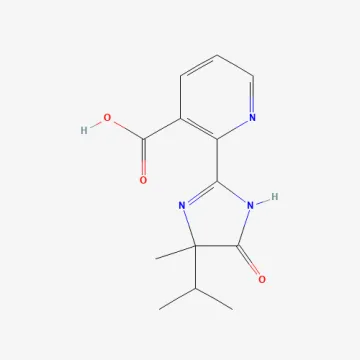
Imazapyr
Description
Mode of action
Imazapyr belongs to the imidazolinone chemical class and functions as a non-selective, systemic herbicide with both contact and residual soil activity.
The active ingredient is absorbed primarily through the foliage, but it also shows significant uptake by plant roots from the soil profile.
Its primary mode of action is the inhibition of the enzyme acetolactate synthase (ALS), which is essential for the synthesis of branched-chain amino acids.
By blocking this metabolic pathway, the herbicide disrupts protein synthesis, causing rapid cessation of plant growth and eventual necrosis.
While the plant stops growing shortly after application, total death of the target vegetation may take several weeks as the plant's metabolic reserves are exhausted.
What it targets
Imazapyr is effective against a broad spectrum of annual and perennial grasses, as well as many broadleaf weed species.
It is particularly valued for its efficacy in controlling woody plants, shrubs, vines, and difficult-to-manage perennial weeds like rhizomatous grasses.
Due to its soil residual properties, it provides long-term control by inhibiting the germination of weed seeds in the treated area.
The product is standardly used for total vegetation management in non-crop areas where complete site clearing is required.
- Railway tracks and road embankments.
- Industrial sites and storage facility perimeters.
- Utility line rights-of-way and pipeline corridors.
- Areas designated for future construction or maintenance of clear zones.
Rates and timing
Application rates for imazapyr are determined based on the target species' sensitivity, plant maturity, and the specific soil type of the treatment area.
The most effective application window is during the period of active vegetative growth when the plants are physiologically receptive to systemic herbicides.
For woody vegetation control, thorough coverage is essential, and applications can be performed throughout the growing season.
Uniform distribution of the spray solution is critical to prevent skipped areas and ensure the product remains effective against resistant species.
Because of its long-lasting effect, re-application is rarely needed within the same growing season, providing significant labor and cost efficiency.
Restrictions
The most significant limitation of imazapyr is its high soil persistence, which renders treated areas unsuitable for subsequent cultivation for extended periods.
The herbicide remains active in the soil, meaning there is a high risk of residual toxicity to non-target crops if planted prematurely after treatment.
Spray drift must be strictly prevented, as even trace amounts can cause severe phytotoxic damage to sensitive crops and off-target vegetation.
Application near sensitive water sources, rivers, or areas where livestock graze must be avoided to prevent environmental contamination and animal toxicity.
Operators must wear appropriate personal protective equipment during handling and application to minimize risks to human health and prevent skin contact.
Status in the European Union
Not approved in the EU
- CAS number
- 81334-34-1
- Category (EU)
- HB - Herbicide
- ADI
- 2.5 mg/kg bw/day
- ARfD
- Not appl.
EU status is for reference only and does not replace national registration in your country.