
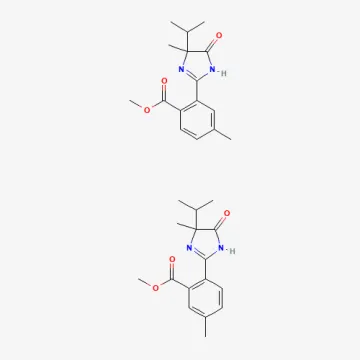
Imazamethabenz
Description
Mode of action
Imazamethabenz belongs to the imidazolinone chemical class, functioning as a systemic herbicide that is primarily absorbed through the roots but can also enter through foliage.
The primary mechanism of action involves the inhibition of the acetolactate synthase (ALS) enzyme, which is crucial for the biosynthesis of essential amino acids.
By blocking the synthesis of valine, leucine, and isoleucine, the herbicide effectively halts plant cell division, leading to the immediate cessation of weed growth.
Visual symptoms, including chlorosis of young leaves and stunted growth, typically appear within several days after the herbicide application.
Complete necrosis and death of susceptible weeds occur within two to four weeks, depending on environmental factors and the physiological state of the plants.
What it targets
This herbicide class is specifically formulated to control a broad range of annual broad-leaved weeds in agricultural systems.
It is particularly effective against highly competitive species such as knotweed, cleavers, pigweed, and various cruciferous weeds found in cereal fields.
Imazamethabenz is primarily used in winter and spring cereal crops, including wheat and barley, to ensure early-season weed management.
The efficacy is maximized when the target weeds are treated at an early growth stage, typically at the seedling to two-leaf growth stage.
- Knotweed species
- Cleavers (Galium aparine)
- Pigweed (Amaranthus)
- Common lambsquarters
- Shepherd's purse
Rates and timing
Application rates for imazamethabenz-based products vary based on soil composition, weed population density, and the specific weed species present in the field.
The optimal timing for application is during the tillering stage of the cereal crop when the weeds are small and actively growing.
The spray volume should be calibrated to ensure uniform coverage of the target area, with standard rates usually ranging from 200 to 300 liters per hectare.
Effective application requires an ambient temperature between +10 and +25 degrees Celsius, as lower temperatures can inhibit the plant's metabolic uptake of the chemical.
Precautions should be taken during spraying to minimize drift, ensuring that the chemical does not reach adjacent sensitive crop fields.
Restrictions
Imazamethabenz exhibits significant soil activity, which necessitates careful consideration of crop rotation schedules to avoid residual phytotoxicity issues.
Applications should be avoided if the crop is suffering from environmental stress, such as drought, extreme cold, or severe pest damage, as this reduces efficacy.
Users must adhere strictly to the label requirements regarding rotational intervals between the application and the planting of subsequent crops.
Before mixing with other pesticides, a compatibility test must be conducted to ensure there are no adverse reactions or negative effects on the mixture's stability.
Always utilize personal protective equipment when handling this herbicide to prevent direct contact with skin or inhalation of spray mist.
Status in the European Union
Not approved in the EU
- CAS number
- 100728-84-5
- Category (EU)
- HB - Herbicide
EU status is for reference only and does not replace national registration in your country.