
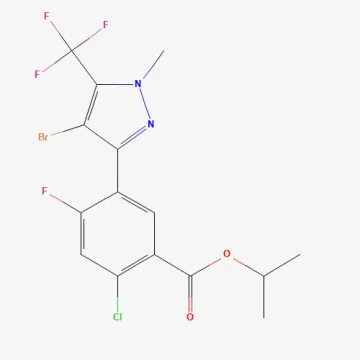
Fluazolate
Description
Mode of action
Fluazolate belongs to the triazolinone chemical class. This modern active substance acts as a systemic herbicide with a pronounced post-emergence effect.
Its mechanism of action is based on the inhibition of the protoporphyrinogen oxidase (PPO) enzyme. Blocking this enzyme leads to the disruption of chlorophyll synthesis and the destruction of cell membranes in susceptible plants.
The preparation is actively absorbed by the green parts of weeds and is quickly transported through the plant's vascular system, causing irreversible degradation processes of tissues.
Within weed cells, the substance triggers the process of lipid peroxidation, leading to rapid wilting and necrosis of leaves under the influence of sunlight.
The effectiveness of the substance directly depends on the intensity of light: the higher the photosynthesis activity, the faster the visual signs of weed mortality appear.
What it targets
Fluazolate is intended for the suppression of a wide range of broad-leaved weeds that compete with main agricultural crops for nutrients and moisture.
The substance is particularly effective against difficult-to-eradicate weed species that show resistance to other herbicide classes, such as certain species of chenopodium, amaranthus, and ambrosia.
The application of the preparation allows for the efficient cleaning of crops from weeds in the early stages of growth, when the crop is most vulnerable to weed competition.
The active substance demonstrates high selectivity, affecting exclusively weeds and causing no damage to the target crop when guidelines are followed.
The key goal of the application is to ensure optimal conditions for crop development during critical growth phases, which significantly increases total yield.
Rates and timing
Fluazolate application rates depend on the weed species composition, their growth stage at the time of treatment, and the climatic conditions of the cultivation region.
The optimal time for applying fluazolate-based herbicides is during the period of active weed growth, typically when plants have two to four true leaves.
It is not recommended to spray during adverse weather conditions, such as strong wind, high air temperature, or forecast heavy precipitation immediately after application.
An important requirement is the uniform distribution of the working solution over the weed leaf surface to achieve maximum absorption.
Adhering to time intervals between treatment and subsequent agrotechnical operations is critical to maintaining the stability of the preparation within the soil horizon.
Restrictions
When working with preparations of this group, it is mandatory to use personal protective equipment for the respiratory tract, skin, and eyes.
The use of the preparation near water bodies and habitats of beneficial pollinating insects is strictly prohibited as it can negatively impact the local ecosystem.
Restrictions include the need to observe pre-harvest intervals before workers enter fields for manual or mechanized tasks following application.
Drift of the working solution onto neighboring fields with sensitive agricultural crops must be avoided, as fluazolate possesses high phytotoxicity.
After finishing operations, the spraying equipment must be thoroughly washed according to the manufacturer's recommendations to prevent environmental contamination.
Status in the European Union
Not approved in the EU
- Category (EU)
- HB - Herbicide
EU status is for reference only and does not replace national registration in your country.