
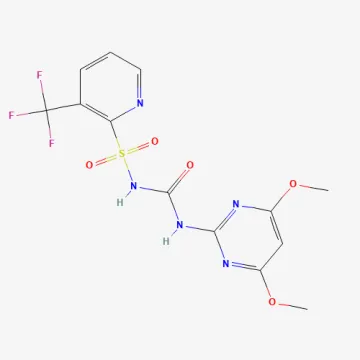
Flazasulfuron
Description
Mode of action
Flazasulfuron belongs to the sulfonylurea chemical class and acts as a highly effective systemic herbicide with selective properties. Once it comes into contact with the plant, it translocates rapidly through the phloem and xylem to the weed's growing points.
The primary biological mechanism involves the inhibition of the acetolactate synthase (ALS) enzyme, which is essential for synthesizing the branched-chain amino acids valine, leucine, and isoleucine.
Blocking this enzyme causes cell division in the meristems to cease immediately, resulting in the rapid cessation of weed growth shortly after application.
Visible symptoms, such as chlorosis and necrosis of the growth points, appear within a few days, with complete weed mortality typically occurring within two to four weeks.
The product exhibits significant soil activity, allowing it to provide residual control of emerging weed flushes through uptake by the root system for a period after application.
What it targets
Flazasulfuron demonstrates high biological efficacy against a wide spectrum of broad-leaved weeds and some grass species in various crop plantings and orchards.
The compound is particularly valuable for controlling persistent perennial weeds, including species of mugwort, dandelion, field bindweed, and various thistle species.
It is effective against many annual weed species such as common lambsquarters, knotweed species, common chickweed, and shepherd's purse, which are commonly found in orchard environments.
It is mainly used in vineyards, potato fields, as well as industrial sites and non-agricultural lands for total vegetation control.
- Suppression of actively growing weeds.
- Control of rhizomatous grasses.
- Suppression of broad-leaved species.
Rates and timing
Application rates for flazasulfuron are extremely low, which is characteristic of sulfonylurea herbicides, typically ranging from 10 to 200 grams of product per hectare depending on the crop and objectives.
Application timing is strictly tied to the weed growth stage, which must be in the active growth phase, generally between the emergence of the first true leaves and the rosette stage.
When used in vineyards, treatment is carried out in the spring during active weed growth, ensuring the spray solution does not contact green parts or trunks of the grapevines.
Ensuring uniform coverage of the weed surface is a crucial condition for high effectiveness, therefore the use of high-quality spraying equipment is recommended.
In drought conditions, the efficacy of the product may decrease; therefore, application is recommended on moist soil or when air humidity is at a sufficient level.
Restrictions
A major limitation when working with flazasulfuron is the high sensitivity of many subsequent agricultural crops to residues in the soil, requiring strict adherence to crop rotation plans.
Spray drift to adjacent fields with sensitive crops must be strictly avoided, as even minimal doses can cause severe stunting or total crop loss.
Prolonged use of flazasulfuron-based products on the same field can lead to the development of herbicide resistance in certain weed species, necessitating rotation with herbicides from other chemical classes.
When preparing tank mixtures, physical compatibility between components must be verified to prevent precipitation and reduction of the active ingredient's efficacy.
Strict compliance with pre-harvest interval (PHI) regulations is mandatory to ensure the absence of herbicide residues in fruits and berries at the time of harvest.
Status in the European Union
Approved in the EU
- CAS number
- 104040-78-0
- Category (EU)
- HB - Herbicide
- Approved from
- 01.08.2017
- Approval until
- 31.07.2032
- ADI
- 0.013 mg/kg bw/day
- ARfD
- 1.0 mg/kg bw
- AOEL
- 0.02 mg/kg bw/day
EU status is for reference only and does not replace national registration in your country.