

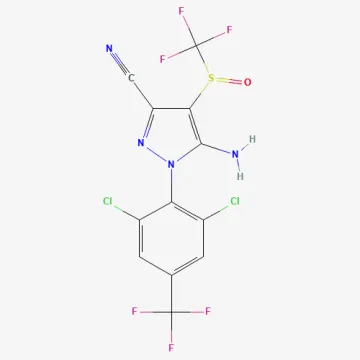
Description
Mode of action
Fipronil is a systemic insecticide belonging to the phenylpyrazole chemical class, widely recognized for its high potency and long-lasting residual control of various pests.
The compound acts by inhibiting the GABA-gated chloride channels in the nervous system of insects. This interruption leads to a massive hyperexcitation of the insect's nervous system, resulting in paralysis and death.
Its systemic nature allows it to be absorbed by seeds or roots, providing protection to emerging seedlings, which is a major advantage in field crop production.
Fipronil remains effective at very low application rates and maintains its stability under various environmental conditions, including exposure to UV light and rain.
It is particularly effective against insect populations that have developed resistance to traditional organophosphate or pyrethroid-based insecticides.
What it targets
Fipronil is primarily utilized for the control of soil-borne pests and various insect species that threaten agricultural productivity across diverse crop groups.
Key targets include wireworms, false wireworms, and grubs, which feed on seeds and roots, often causing severe crop loss and uneven plant stand density.
In addition to subterranean pests, the active ingredient is effective against various orthopteran and coleopteran species, offering flexibility in different pest management programs.
It is extensively used in the production of corn, soybeans, potatoes, and sunflowers to prevent early-season damage caused by soil-dwelling pests.
- Wireworms (Elateridae)
- White grubs (Scarabaeidae)
- Mole crickets (Gryllotalpidae)
- Termites and various beetle larvae
Rates and timing
The application rate for Fipronil varies significantly based on the formulation (e.g., seed treatment, granular soil application, or foliar spray) and the target pest species.
For seed treatment applications, dosage is meticulously calculated to ensure enough active ingredient is delivered to the root zone without causing phytotoxicity to the seed.
Soil application techniques require uniform incorporation to ensure that the active ingredient is concentrated in the area where the target pests reside, maximizing the effectiveness of the treatment.
Adherence to pre-harvest intervals is essential to ensure that residues in the final harvested produce remain well below established safety thresholds.
When mixing with other agricultural chemicals, compatibility testing is required to prevent the degradation of the active ingredient and ensure the efficacy of the tank mix.
Restrictions
Fipronil is highly toxic to bees and aquatic organisms, necessitating strict adherence to environmental safety protocols to protect pollinators and water resources.
Applications should not be performed during crop flowering or when bees are actively foraging in the field or on surrounding weeds to minimize off-target exposure.
Operators must wear appropriate personal protective equipment (PPE), including chemical-resistant gloves and respiratory protection, when handling or applying the concentrated product.
To mitigate the risk of resistance development in insect populations, Fipronil should be used in rotation with insecticides possessing different modes of action.
Storage must be restricted to designated, locked areas away from food, animal feed, and water supplies to prevent accidental contamination or ingestion.
Regulatory
Status in the European Union
Not approved in the EU
- CAS number
- 120068-37-3
- Category (EU)
- IN - Insecticide
- Approved from
- 01.10.2007
- Approval until
- 30.09.2017
- ADI
- 0.0002 mg/kg bw/day
- ARfD
- 0.009 mg/kg bw
- AOEL
- 0.0035 mg/kg bw/day
Hazard classification (CLP)
Acute Tox. 3 - H301Acute Tox. 3 - H311Acute Tox. 3 - H331Aquatic Acute 1 - H400Aquatic Chronic 1 - H410STOT RE 1 - H372
EU legislation
EU status is for reference only and does not replace national registration in your country.
Content graph
Connections · Fipronil
Most often together:
Marketplace
Products · 15


Cosmos 500
БАСФ Агро БВ, Швейцарія, на заводі , Франція,Італія (Сієна)
Insecticides
0
0
·
41
1 offer
1 380.87 €per pack
Buy


