
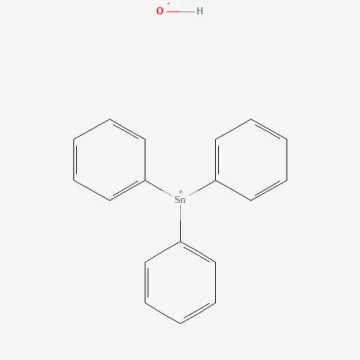
Fentin hydroxide
Description
Mode of action
Fentin hydroxide belongs to the organotin chemical class and functions as a broad-spectrum contact fungicide. Unlike systemic pesticides, it does not penetrate plant tissues; instead, it forms a protective barrier on leaf and stem surfaces, effectively preventing fungal spore germination.
The biological mode of action is based on the inhibition of oxidative phosphorylation within the mitochondria of harmful organisms. This disruption of cellular energy metabolism leads to the death of the pathogen or a significant reduction in its biological viability.
Products containing fentin hydroxide also demonstrate specific antifeedant properties, suppressing the appetite of various insect pests. This makes the compound versatile, acting not only as a fungicide but also as an auxiliary agent against certain types of mites and insect larvae.
Due to its high lipophilicity, the active ingredient exhibits excellent adhesion to the waxy cuticle of crop plants. This provides reliable protection even during light rainfall, although optimal efficacy requires uniform coverage of all plant foliage.
The active substance remains stable across a wide temperature range; however, its overall effectiveness depends heavily on the quality of the spray solution and uniform application. As it lacks translaminar properties, repeated applications are necessary to protect new, non-sprayed plant growth.
What it targets
Fentin hydroxide is primarily used to control a range of fungal diseases in vegetable and industrial crops. It is most valued for controlling potato and tomato late blight, where it demonstrates high efficacy against the zoospores of the pathogen.
The compound effectively suppresses the development of Cercospora leaf spot in sugar beets, preventing premature wilting and optimizing sugar accumulation. It is also effective against Alternaria and various other leaf spot diseases affecting crop foliage.
In orchards and vineyards, the compound is applied to control apple and pear scab. Its contact action allows for the effective blocking of both primary and secondary infection spreads when preventive treatments are applied in a timely manner.
In some regions, fentin hydroxide is utilized as an effective acaricide to manage populations of plant-feeding mites. By disrupting the metabolism of these pests, it reduces female fertility and slows the development of larval stages.
Furthermore, it is notable for its efficacy against anthracnose in leguminous crops. Applying this preparation helps preserve the integrity of the vegetative mass and increases total yield by preventing fruit and foliage damage.
Rates and timing
Application rates vary depending on the specific crop, the severity of the disease pressure, and prevailing weather conditions. Typical dosage ranges correspond to 0.5–1.0 kg of the active ingredient per hectare during field spraying.
The timing of applications is determined by phytosanitary monitoring. The first spraying should ideally occur at the initial appearance of disease symptoms or when conditions favorable for pathogen development, such as high humidity and moderate temperatures, are forecasted.
The interval between treatments during the active growing season typically ranges from 7 to 14 days. It is crucial to follow management protocols to avoid the development of pathogen resistance by alternating fentin hydroxide with fungicides from different chemical classes.
To prepare the spray solution, a mother liquor should be prepared first. The required amount of the product is added to the sprayer tank half-filled with water under constant agitation, after which the remaining water is added to reach the desired volume.
During application, it is essential to monitor nozzle pressure to ensure a fine and uniform spray pattern. The use of adjuvants can improve penetration and retention on the leaf surface, though chemical compatibility must be verified prior to mixing.
Restrictions
Fentin hydroxide is highly toxic to aquatic organisms, and strict adherence to buffer zones near water bodies is mandatory. Direct discharge of the product or its residues into open water, drainage ditches, or sewage systems is strictly prohibited.
There are strict pre-harvest interval (PHI) requirements that must be followed to prevent residue levels from exceeding safety standards in food crops. These intervals vary based on the specific crop type and the local climatic region.
Personnel handling the product must wear appropriate personal protective equipment, including respirators, goggles, gloves, and protective clothing. Contact with skin or mucous membranes must be avoided, as the substance exhibits irritant properties.
Treatments during the flowering stage are prohibited if bees or other pollinators are active in the area. Furthermore, it is not recommended to use this compound in mixtures with strong oxidizing agents or products with an alkaline reaction.
The product must be stored in its original sealed packaging in a dry, cool place, specifically designated for pesticides, and out of reach of children or animals. After the expiration date, remaining stocks must be disposed of in accordance with local environmental regulations.
Status in the European Union
Not approved in the EU
- CAS number
- 76-87-9
- Category (EU)
- HB - Herbicide
- ADI
- 0.0004 mg/kg bw/day
- ARfD
- 0.001 mg/kg bw
EU status is for reference only and does not replace national registration in your country.