
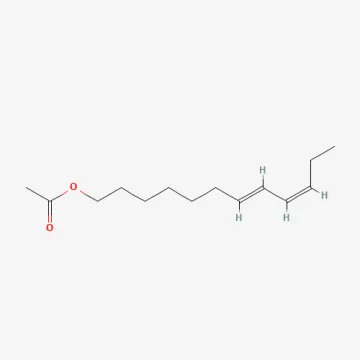
(E,Z)-7,9-Dodecadien-1-yl acetate
Description
Mode of action
This compound is a synthetic analogue of a lepidopteran sex pheromone, specifically designed to attract and disrupt the mating behavior of target insect species.
The core mechanism is mating disruption, which involves flooding the orchard with a high concentration of the pheromone to mask the scent trails released by females.
By interfering with the chemical communication between males and females, the compound prevents the fertilization of eggs, thereby breaking the pest's reproductive cycle.
As a biological control tool, it does not kill insects through toxic means, but rather reduces the population through the failure of successful mating events.
This approach is environmentally friendly as it is highly specific to the target species and does not harm beneficial insects like bees or predatory wasps.
What it targets
The primary target pest for this pheromone is the codling moth (Cydia pomonella), a major global pest of pome fruit orchards.
It is also effectively used to control various species of leafrollers that share similar pheromone chemical compositions.
The substance is widely applied in apple and pear orchards where precise control of internal fruit-feeding larvae is essential for high-quality production.
It plays a critical role in Integrated Pest Management (IPM) and organic farming programs, providing an alternative to traditional broad-spectrum insecticides.
- Codling moth
- Leafrollers
- Related Tortricid moths
Rates and timing
Application rates depend on whether the substance is used for population monitoring or as part of a large-scale mating disruption program.
For monitoring purposes, a few dispensers per hectare are sufficient to detect the start of the flight period and determine the risk levels.
Full-scale mating disruption requires the deployment of a high density of dispensers throughout the orchard to maintain a constant pheromone atmosphere.
The installation must be completed before the first seasonal flight of the moths, typically coinciding with the early stages of bloom.
Most dispensers are engineered to release the active ingredient continuously for 60 to 90 days, covering the main activity periods of multiple moth generations.
Restrictions
The efficacy of the mating disruption technique is best achieved in large, contiguous orchard blocks to avoid the influx of mated females from neighboring untreated areas.
Environmental factors such as high wind speeds or extreme heat can accelerate the dissipation of the pheromone, potentially reducing the duration of its effectiveness.
Proper storage is vital; the compound is sensitive to heat and UV radiation, which can degrade its chemical structure before field application.
This method may not be sufficient on its own if the initial pest population density in the orchard is excessively high, requiring supplementary control measures.
Correct placement within the canopy of the trees is necessary to ensure optimal distribution of the pheromone vapors throughout the orchard environment.
Status in the European Union
Approved in the EU
- CAS number
- 54364-62-4
- Category (EU)
- AT - Attractant
- Approved from
- 01.09.2022
- Approval until
- 30.08.2037
EU status is for reference only and does not replace national registration in your country.