

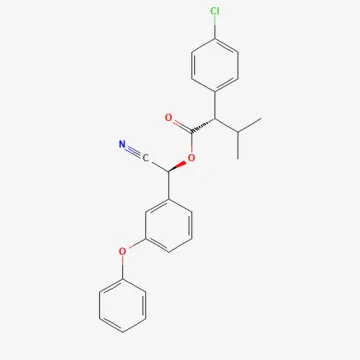
Description
Mode of action
Esfenvalerate is a synthetic pyrethroid insecticide that acts primarily through contact and ingestion. It targets the nervous system of insects by disrupting the function of voltage-gated sodium channels in nerve cell membranes.
The chemical induces a state of continuous nerve impulse transmission in the pest, leading to hyper-excitation, paralysis, and eventually death. This rapid onset of action is characteristic of its high biological efficacy.
Known for its immediate "knockdown" effect, esfenvalerate effectively halts insect feeding activity shortly after application. Its lipophilic nature allows for rapid penetration through the insect cuticle upon contact.
While esfenvalerate provides a strong initial impact, it also offers a residual effect that maintains control over a period following the application. The duration of this protection is influenced by environmental conditions such as temperature and UV radiation.
Since the compound lacks systemic properties, successful control relies heavily on achieving thorough coverage of the plant surface. Proper spray calibration is essential to ensure that the chemical reaches all areas where pests are present.
What it targets
This active ingredient is widely utilized to control a broad spectrum of insect pests belonging to the orders Lepidoptera, Coleoptera, and Homoptera. It is highly effective against both adult and larval stages of various agricultural pests.
Common targets include the Colorado potato beetle in potatoes, various species of cutworms, aphids, leafrollers, and codling moths in orchards. It is also extensively used to manage cereal bugs in small grain crops.
Esfenvalerate provides effective control of cabbage moth, white butterflies, and flea beetles in vegetable production. It is a critical tool for managing outbreaks and maintaining pest populations below economic injury levels.
The chemical is effective against most foliage-feeding insects encountered in field and horticultural crops. Its broad-spectrum activity makes it a versatile choice for integrated pest management programs.
Because the insecticide is not ovicidal against all species, application timing is crucial. Scouting for larval and adult activity is necessary to determine the most effective window for intervention.
Rates and timing
Application rates for esfenvalerate depend on the specific crop, pest pressure, and local conditions. Typical usage rates range from 0.1 to 0.4 liters of formulated product per hectare to achieve optimal results.
The timing of applications should be dictated by regular field monitoring and the economic threshold for the specific pest. Early intervention upon pest discovery is generally recommended to prevent significant crop damage.
Spray solutions are prepared by diluting the insecticide in water. Standard practice for field crops involves using a water volume of 200–400 liters per hectare to ensure adequate leaf coverage.
If necessary, repeat applications may be performed at 10–14 day intervals. To mitigate the risk of pest resistance, it is advised to rotate esfenvalerate with insecticides from different chemical classes.
To maximize effectiveness and reduce drift, spraying should be conducted during calm, cool weather, such as early morning or late evening. This helps minimize evaporation and potential degradation from sunlight.
Restrictions
Esfenvalerate is highly toxic to bees and other beneficial insects. Applications must be avoided during flowering stages, and local beekeepers should be notified well in advance to prevent collateral damage to pollinators.
The substance is classified as hazardous and requires the use of appropriate personal protective equipment (PPE) during handling and application. Eating, drinking, or smoking is strictly prohibited while working with the product.
Strict adherence to pre-harvest intervals (PHI), ranging from 20 to 40 days, is essential to ensure that residues in the final food product remain within established legal safety limits.
The compound is toxic to aquatic life. Applications must be managed to prevent spray drift into water bodies, and any surplus solution or container rinsing must be disposed of in accordance with environmental regulations.
Storage must be in original containers, in a cool, dry, and well-ventilated area, away from reach of children, animals, food, or animal feed. Proper site management prevents accidental exposure and contamination.
Regulatory
Status in the European Union
Approved in the EU
- CAS number
- 66230-04-4
- Category (EU)
- IN - Insecticide
- Approved from
- 01.01.2016
- Approval until
- 31.05.2026
- ADI
- 0.0175 mg/kg bw/day
- ARfD
- 0.0175 mg/kg bw
- AOEL
- 0.011 mg/kg bw/day
Hazard classification (CLP)
Acute Tox. 3 - H301Acute Tox. 3 - H331Aquatic Acute 1 - H400Aquatic Chronic 1 - H410Skin Sens. 1 - H317
EU legislation
EU status is for reference only and does not replace national registration in your country.
Content graph
Connections · Esfenvalerate
Most often together:
Marketplace