
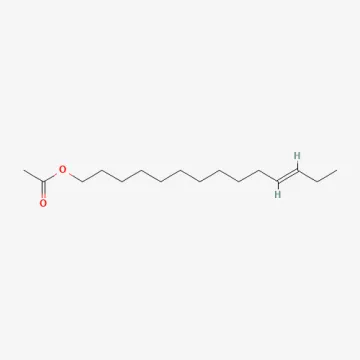
(E)-11-Tetradecen-1-yl acetate
Description
Mode of action
(E)-11-tetradecen-1-yl acetate belongs to the class of synthetic insect sex pheromones, which are essential tools in modern integrated pest management strategies.
The action mechanism is based on disrupting the mating communication of insects by saturating the air with the synthetic volatile compound from dispensers.
This process prevents males from locating females, thereby reducing or preventing successful mating and curbing the pest's reproductive cycle in the target area.
Known as mating disruption, this technique is an eco-friendly approach that manages pest populations without relying on broad-spectrum toxic insecticides.
Because the action is strictly behavioral and species-specific, it has no adverse effects on beneficial insects, such as pollinators and natural predators.
What it targets
The substance is primarily used against various Lepidoptera species, for which this chemical is a key component of their natural pheromone blend.
The main targets include several types of fruit moths, such as the Oriental fruit moth, as well as specific noctuid moths that damage orchard fruits.
It is widely applied in high-intensity fruit orchards and vineyards where meeting residue-free standards for export or organic production is a priority.
By targeting the specific biological communication of these pests, growers can achieve precise control without negatively affecting the orchard ecosystem.
The use of this pheromone is a critical component of pest management programs designed to minimize reliance on conventional chemical inputs.
Rates and timing
Timing for dispenser deployment is based on field monitoring data, with devices typically installed just before the onset of the pest's flight season.
Application rates are calculated based on the number of dispensers per hectare, ensuring a sufficient concentration of the pheromone throughout the orchard canopy.
One set of dispensers usually provides protection for several months, effectively covering the period of the pest's reproductive activity in the field.
Proper distribution of dispensers is crucial to ensure a uniform pheromone cloud, which is necessary for effective mating disruption across the entire area.
Integration with other biological control measures is recommended when initial pest pressure is high to ensure effective population management throughout the season.
Restrictions
The effectiveness of mating disruption is highly dependent on the size of the treated plot, as smaller areas are more prone to migration from outside sources.
Strict storage protocols must be followed for the dispensers to maintain the integrity of the active ingredient before deployment in the field.
The substance is not a knockdown insecticide and will not immediately eliminate an existing high-level pest infestation within an orchard.
Environmental factors, such as extreme heat and high wind speeds, can influence the evaporation rate, potentially reducing the field life of the product.
Concurrent use of broad-spectrum chemical sprays should be minimized to avoid interfering with the natural behavioral patterns that this pheromone system targets.
Status in the European Union
Approved in the EU
- CAS number
- 33189-72-9
- Category (EU)
- AT - Attractant
- Approved from
- 01.09.2022
- Approval until
- 30.08.2037
- ADI
- Not appl.
- ARfD
- Not appl.
- AOEL
- Not appl.
EU status is for reference only and does not replace national registration in your country.