
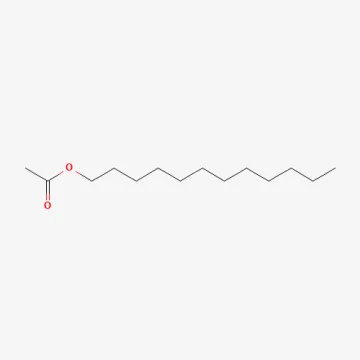
Dodecyl acetate
Description
Mode of action
Dodecyl acetate belongs to the class of aliphatic acetates and is a key component of synthetic insect pheromones. Its action is based on mimicking natural sexual attractants that females release to lure males.
Unlike classic insecticides, this substance has no toxic effect and does not destroy pests through direct poisoning. It works as a highly specific biological signal that governs insect behavior.
The mechanism consists in the disorientation of males in space. In high concentrations, the use of this substance leads to a disruption of the mating search process, which prevents mating and reduces the overall pest population in the area.
The substance is a volatile compound that is gradually released from a dispenser, creating a "pheromone cloud" in the air. This allows for effective population control without impacting beneficial entomofauna.
This tool fits perfectly into the concept of Integrated Pest Management (IPM) as it completely eliminates the accumulation of pesticides in produce and the environment.
What it targets
Dodecyl acetate in pheromone mixtures is used to control Lepidoptera pests, particularly members of the leafroller and looper families.
The main objects of application are fruit crops, such as apples, pears, plums, and cherries, where pests cause direct damage to the quality of the fruit.
The substance is effective against species for which it is the primary component of their species-specific pheromone, ensuring high selectivity of attraction.
Application is relevant both in large commercial orchards and in organic farming, where the use of chemical pesticides is limited by strict regulations.
Also, dodecyl acetate is used in forestry to monitor populations of pests affecting coniferous and deciduous trees during their flight period.
Rates and timing
Dodecyl acetate application rates depend on the specific type of dispenser and the duration of the crop's growing season.
Typically, a dispenser containing a metered amount of the substance, designed for 4–6 weeks of active evaporation, is placed inside each trap.
The timing of trap placement is linked to the start of the first generation flight of the pest, which is determined by climatic data and crop phenology.
The frequency of inspection and replacement of dispensers is adjusted based on the temperature regime, as the rate of evaporation is directly dependent on weather conditions.
It is important to observe trap spacing intervals (usually 1 trap per 1–5 hectares for monitoring) to avoid oversaturating the territory with pheromone background during mass trapping.
Restrictions
The main limitation is narrow specificity: the pheromone attracts only males of specific species, so high-quality monitoring of species composition is required for comprehensive control.
The effectiveness of the product can be significantly reduced by extreme temperatures, strong winds, or prolonged precipitation, which disrupt the stability of evaporation.
It is not recommended to store dispensers near food products or in places with access to direct sunlight, as this leads to the degradation of the active substance.
When working with pheromones, gloves should be used to prevent skin contact with the active substance and to avoid transferring the scent to other objects.
It should be noted that with high pest density in the current season, pheromone traps alone may not be sufficient for crop protection, necessitating combination with other methods.
Status in the European Union
Approved in the EU
- CAS number
- 112-66-3
- Category (EU)
- AT - Attractant
- Approved from
- 01.09.2022
- Approval until
- 30.08.2037
- ADI
- Not appl.
- ARfD
- Not appl.
- AOEL
- Not appl.
EU status is for reference only and does not replace national registration in your country.