
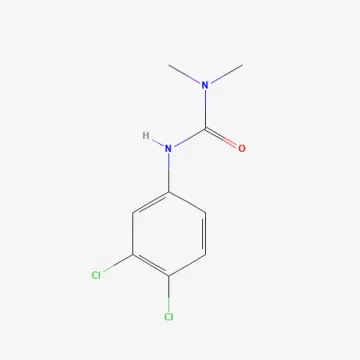
Diuron
Description
Mode of action
Diuron belongs to the phenylurea chemical class and acts as a systemic herbicide. Its primary mechanism involves blocking the photosynthesis process in target plants.
The substance is absorbed mainly through the root system from the soil solution. Partial uptake through leaf surfaces can also occur during direct foliar spraying.
Once inside the plant, diuron is translocated via the xylem to the leaves. There, it inhibits electron transport in photosystem II, effectively halting photosynthesis.
The lack of synthesized organic matter leads to chlorosis, tissue necrosis, and eventual plant death. The speed of action depends on photosynthetic activity and soil moisture conditions.
Its long-lasting soil residual activity allows for protecting crops against multiple flushes of weeds over an extended period after application.
What it targets
Diuron is utilized to control a wide spectrum of annual broadleaf weeds and some grasses. It is effective against species such as pigweed, common lambsquarters, shepherd's purse, and knotweeds.
In agricultural practice, it is used on cotton, vineyards, fruit orchards, and sugarcane plantations. It is also applied for vegetation control on industrial sites.
- Highly effective against germinating weed seedlings.
- Shows moderate activity against perennial species at high application rates.
- Suppresses algae development under specific agricultural conditions.
The choice of this herbicide is justified for heavily infested fields that require a persistent chemical barrier within the soil.
The efficacy of the product significantly increases with sufficient soil moisture, which is necessary for active uptake of the active ingredient by weed roots.
Rates and timing
Application rates for diuron vary from 1.0 to 4.0 kg of active ingredient per hectare, depending on soil texture and the weed species present.
On light sandy soils, minimal dosages should be used to prevent leaching of the herbicide into the root zone of the target crops.
The optimal application timing is pre-planting or pre-emergence. In orchards and vineyards, application is performed before the growing season or against established weeds.
Uniform distribution of the spray solution over the soil surface is critical. It can be used in tank mixes to broaden the spectrum of controlled weeds.
The frequency of application is strictly regulated based on specific crop registrations to prevent the accumulation of residues in the harvest.
Restrictions
A primary limitation is the high persistence of diuron in the soil, which requires careful crop rotation planning to avoid phytotoxicity for sensitive follow-up crops.
Application on very light soils with low organic matter content is not recommended due to the risk of crop damage caused by rainwater leaching.
Personal protective equipment for skin and respiratory protection is essential when handling the product, as the substance may cause irritation.
Avoid spray drift onto neighboring sensitive agricultural crops that are susceptible to phenylurea herbicides.
Storage must be carried out in sealed containers away from food and feed, in facilities with controlled temperature conditions.
Status in the European Union
Not approved in the EU
- CAS number
- 330-54-1
- Category (EU)
- HB - Herbicide
- Approved from
- 01.10.2008
- Approval until
- 30.09.2020
- ADI
- 0.007 mg/kg bw/day
- ARfD
- 0.016 mg/kg bw
- AOEL
- 0.007 mg/kg bw/day
EU status is for reference only and does not replace national registration in your country.