
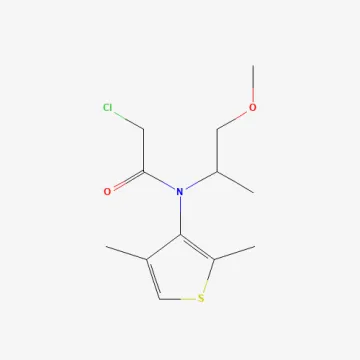
Dimethenamid
Description
Mode of action
Dimethenamid belongs to the chloroacetamide chemical class. It is a highly effective herbicide that exhibits significant systemic action. The product is absorbed by the sprouts and roots of weeds during their germination from seeds.
The mechanism of action involves the inhibition of cell division, which stops the growth of meristematic tissues. Dimethenamid disrupts the synthesis of proteins, lipids, and anthocyanins in the plant, making its further development impossible.
The active substance blocks the activity of enzymes responsible for forming cell membrane components. As a result, weeds die before they emerge on the soil surface or immediately after germination.
The product features high mobility in the topsoil layer, which provides a reliable protective barrier. The effectiveness of the substance directly depends on the presence of soil moisture, which is necessary for its activation.
Dimethenamid differs from older analogs by its ability to provide a long period of protective action (up to 6–8 weeks), which is critically important for protecting crops during early growth phases.
What it targets
The primary targets for this substance are annual grass weeds, such as barnyard grass, foxtail species, crabgrass, and finger grass. These weeds are capable of causing significant yield losses in row crops.
The product also shows activity against some broad-leaved weed species, including amaranth, common lambsquarters, and knotweed. However, its core specialization is the grass component of weed infestation.
The effect of the product on broad-leaved weeds is usually suppressive, so in intensive technologies, it is often combined with other herbicides to broaden the spectrum of action.
There is practically no effect on perennial weeds that propagate vegetatively. Additional agrotechnical or chemical methods are required to control them.
- Barnyard grass (Echinochloa crus-galli)
- Foxtail (Setaria spp.)
- Crabgrass (Digitaria spp.)
- Common lambsquarters (Chenopodium album)
- Amaranth (Amaranthus spp.)
Rates and timing
Application rates for the product vary depending on the soil type and the degree of field infestation. On light soils with low humus content, minimum doses are usually used to prevent phytotoxicity.
On heavy, high-humus soils, an increase in the rate of the active substance is required to ensure a sufficient concentration of the herbicide in the soil solution.
The product can be applied either before sowing (with incorporation) or after sowing but before crop emergence. It is critically important to apply the product within 2–3 days after sowing.
For high-quality soil coverage with the working solution, it is recommended to use between 200 and 300 liters of water per hectare. Ensuring uniform application is key to successful weed control.
When used in tank mixtures, rates may be adjusted by an agronomist taking into account the regulations for specific partner products, which can significantly enhance the final effect.
Restrictions
The main limitation is the need for sufficient soil moisture after application. Under severe drought conditions, the herbicide's effectiveness is significantly reduced, which requires a change in the protection strategy.
It is not recommended to cultivate the soil after applying the herbicide, as this destroys the integrity of the barrier and reduces the protective properties of the product against newly germinating weed seeds.
When using the product, it is necessary to avoid drift onto sensitive crops, as it has high biological activity. Adherence to field boundaries is a mandatory requirement.
In the case of re-sowing a field after the loss of the main crop (e.g., due to weather conditions), the choice of the following crop is limited. It is usually recommended to sow maize or soybeans, which show resistance.
Storage and handling of the product must be carried out strictly using personal protective equipment, considering the toxicity of the active substance to humans and the environment if handled improperly.
Status in the European Union
Not approved in the EU
- CAS number
- 87674-68-8
- Category (EU)
- HB - Herbicide
- ADI
- 0.02 mg/kg bw/day
- ARfD
- 0.25 mg/kg bw
- AOEL
- 0.04 mg/kg bw/day
EU status is for reference only and does not replace national registration in your country.