
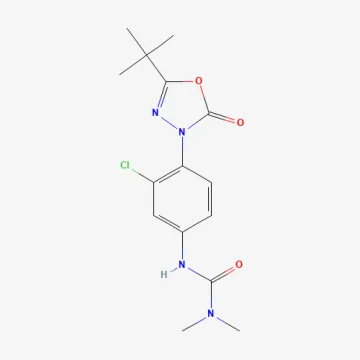
Dimefuron
Description
Mode of action
Dimefuron belongs to the phenylurea chemical class. Like other members of this group, it acts as a photosynthesis inhibitor by targeting photosystem II within the chloroplasts of target weeds.
The substance is primarily absorbed through the root system of germinating weeds and is subsequently translocated via the xylem to the aerial parts of the plant. This blockage of photosynthesis leads to growth inhibition and eventual plant death.
Products based on dimefuron are characterized by their soil activity, creating a protective chemical barrier in the top layer of the soil that prevents weed seeds from germinating.
The effectiveness of dimefuron is directly dependent on soil moisture, which is essential for the dissolution of the active ingredient and its movement into the weed root zone.
This compound possesses selective phytotoxicity, allowing crop plants to metabolize the herbicide effectively without showing signs of suppression when label dosages are followed.
What it targets
Dimefuron is traditionally used to control a wide spectrum of annual broadleaf weeds and some grasses during their early stages of development.
Species such as common lambsquarters, various knotweeds, pigweed, common chickweed, and shepherd's purse exhibit high sensitivity to dimefuron application.
The herbicide is effective against weeds with seeds located near the soil surface, ensuring crop cleanliness during the most critical period of vegetation.
The range of susceptible weed species may expand slightly depending on soil and climatic conditions and the concentration of the active ingredient in the spray solution.
Applying this product reduces the competitive pressure on crop seedlings, which is vital during the early establishment of root systems and leaf area.
Rates and timing
Application rates for dimefuron are determined by the specific crop being grown, the mechanical composition of the soil (particularly organic matter content), and the expected weed spectrum.
The optimal timing for application is pre-planting or immediately post-planting, but always before the emergence of the crop seedlings.
Quality soil preparation is an essential requirement; the surface should be finely crumbled and free of large clods to ensure uniform distribution of the herbicide.
In arid conditions, it is necessary to incorporate the product into the soil at a shallow depth to ensure contact with the moist soil environment.
It is recommended to avoid any subsequent soil disturbance, such as cultivating or harrowing, after application to maintain the integrity of the herbicidal barrier.
Restrictions
The use of dimefuron on soils with high organic matter content may reduce its biological activity due to the adsorption of herbicide molecules by humus particles.
Avoid application on light sandy soils with low organic content, as there is a risk of the active ingredient leaching into deeper soil horizons, which could damage crop roots.
Strict adherence to crop rotation plans is necessary, as residual amounts of phenylurea herbicides can affect sensitive crops planted in subsequent seasons.
When handling the product, personal protective equipment for skin, eyes, and respiratory protection must be worn, and drift onto neighboring agricultural fields must be prevented.
Storage should be in original containers within dry, cool warehouses, kept away from children, pets, and any sources of ignition.
Status in the European Union
Not approved in the EU
- CAS number
- 34205-21-5
- Category (EU)
- HB - Herbicide
EU status is for reference only and does not replace national registration in your country.