
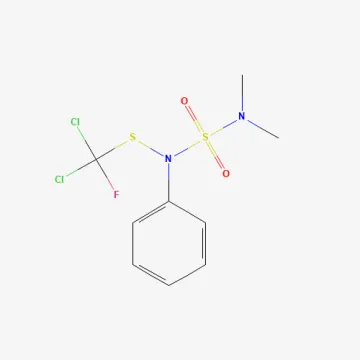
Description
Mode of action
Dichlofluanid belongs to the sulfamide chemical class and acts as a potent contact fungicide with broad-spectrum activity against various fungal pathogens.
Its mechanism of action involves the inhibition of key enzymes in the fungal cell, which prevents spore germination and mycelium expansion on plant surfaces.
Because it is a contact-only agent, the compound does not penetrate deeply into plant tissues, ensuring minimal residue levels in the harvested fruit or vegetables.
The formulation typically features strong adhesive properties, allowing the active ingredient to remain effective on leaves even under challenging environmental conditions.
It acts as a protective barrier that interferes with the metabolic processes of fungi, making it an essential tool for preventing primary infections in crops.
What it targets
The substance is primarily utilized for the management of diseases caused by Ascomycetes and Deuteromycetes in both field and greenhouse environments.
It is widely recognized for its efficacy against grey mold (Botrytis cinerea), which frequently compromises berry and vegetable production.
The fungicide is effective in controlling scab (Venturia spp.) on fruit trees, protecting both foliage and the developing skin of the fruit.
It is used to suppress various types of rusts, leaf spots, and powdery mildew that thrive in high-humidity cultivation settings.
Dichlofluanid serves as a reliable solution for maintaining the health of various ornamental plants by preventing fungal colonization of stems and leaves.
Rates and timing
Application rates for Dichlofluanid vary depending on the crop type, disease pressure, and the specific application technology used.
Treatments should ideally be applied as a preventative measure or at the very onset of the first symptoms to ensure optimal control of fungal outbreaks.
Standard orchard programs involve several sprays during the critical growth stages, starting from early budding to the final stages of fruit development.
Application intervals are typically spaced 10 to 14 days apart, depending on environmental factors like humidity levels and rainfall patterns.
Ensuring complete coverage of the plant canopy is essential for maximizing the efficacy of this contact fungicide during the vegetative stage.
Restrictions
Dichlofluanid must be handled with appropriate personal protective equipment to avoid skin irritation and respiratory exposure during mixing and spraying.
The chemical is toxic to aquatic organisms, requiring strict adherence to buffer zones near water bodies to prevent runoff and environmental contamination.
Users should strictly follow the pre-harvest interval (PHI) specified on the product label to ensure that residues remain within safe regulatory limits.
It should be stored in a well-ventilated, dry storage area, away from food, feed, and heat sources, within its original, clearly labeled packaging.
Tank mixing with other chemicals should be validated by a compatibility test to avoid potential phytotoxicity or reduced efficacy of the active component.
Regulatory
Status in the European Union
Not approved in the EU
- CAS number
- 1085-98-9
- Category (EU)
- FU - Fungicide
- ADI
- 0.3 mg/kg bw/day
Hazard classification (CLP)
Acute Tox. 4 - H332Aquatic Acute 1 - H400Eye Irrit. 2 - H319Skin Sens. 1 - H317
EU legislation
EU status is for reference only and does not replace national registration in your country.
Content graph
Connections · Dichlofluanid
Most often together:
Marketplace