
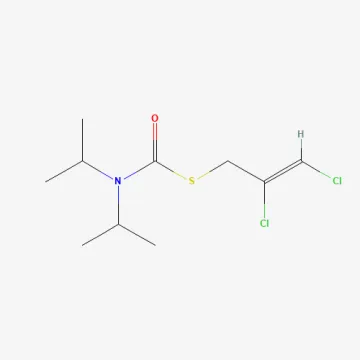
Di-allate
Description
Mode of action
Diallate belongs to the thiocarbamate chemical class and functions as a highly selective soil-applied herbicide. Its primary mechanism of action involves the inhibition of growth processes in weeds during their earliest developmental stages.
The active substance is absorbed by weed seedlings through the coleoptile or mesocotyl immediately as they emerge from the seed. This disrupts cell division in meristematic tissues, resulting in the cessation of growth and subsequent plant death.
Products in this group demonstrate strong suppressive effects on seeds before the emergence of shoots above the soil surface. Efficacy is highly dependent on sufficient soil moisture for the activation of the chemical.
After application, diallate requires immediate incorporation into the soil to a depth of 2-5 centimeters. This agrotechnical step is necessary to prevent the loss of the active substance through volatilization under sunlight.
The systemic action of the compound provides a reliable protective barrier for crops during the critical early vegetation period when weed competition is most detrimental.
What it targets
The primary target of diallate is annual grass weeds, particularly wild oat (Avena fatua). Historically, it has been an essential tool for maintaining clean grain fields infested with this difficult-to-control species.
In addition to wild oat, diallate effectively suppresses the development of various foxtail species and other annual grasses, facilitating easier crop management during the initial stages.
The herbicide has little effect on broadleaf weeds, which often necessitates its use in tank mixtures or as part of a specialized integrated weed management program.
The selectivity of the compound allows it to be used on agricultural crops that possess natural tolerance to thiocarbamates at recommended application rates.
The success of the treatment directly depends on the quality of soil preparation and the uniformity of the application within the horizon where weed seeds are concentrated.
Rates and timing
Application rates for diallate vary based on soil type, humus content, and the intensity of weed infestation. Lighter soils generally require lower dosages compared to heavier, organic-rich soils.
Application must be performed only before crop planting with mandatory soil incorporation. Post-emergence application is not permitted due to the high risk of crop phytotoxicity.
The optimal time for application is during pre-planting cultivation, allowing for efficient integration of weed control with standard soil preparation operations.
Strict adherence to the specified incorporation depth is crucial, as improper mixing can result in uneven distribution of the active ingredient and reduced herbicidal efficacy.
Repeating applications on the same plot within a single season is not recommended to avoid the buildup of chemical residues in the soil profile.
Restrictions
When working with diallate, it is mandatory to use personal protective equipment, including respirators, gloves, and protective clothing, as the substance may cause irritation to skin and mucous membranes.
The product must be kept away from water bodies and drinking water sources due to its toxicity to aquatic life. Wind speed and direction must be strictly monitored during spraying.
Crop rotation planning should account for potential restrictions following diallate use. Waiting periods must be observed to avoid negative carryover effects on subsequent crops.
Storage should take place in dry, cool, well-ventilated areas in original, tightly closed containers, kept away from children, unauthorized personnel, and animals.
Disposal of chemical waste and empty containers must be carried out in accordance with local environmental regulations and by authorized disposal services.
Status in the European Union
Not approved in the EU
- CAS number
- 2303-16-4
- Category (EU)
- HB - Herbicide
EU status is for reference only and does not replace national registration in your country.