
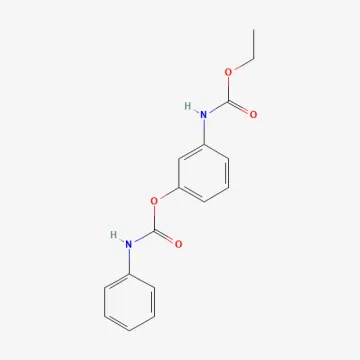
Desmedipham
Description
Mode of action
Desmedipham belongs to the phenylcarbamate chemical class and functions as a highly selective post-emergence contact herbicide.
The substance enters the plant primarily through the leaf surface with minimal movement via the xylem, requiring thorough spray coverage of target weeds for optimal results.
The mode of action involves inhibiting photosynthesis by blocking electron transport in photosystem II, which leads to growth arrest and subsequent mortality of sensitive species.
The product exhibits exceptional selectivity, allowing for safe use in sugar beet, red beet, and fodder beet fields without causing phytotoxicity to the crop.
Effectiveness of desmedipham is highly dependent on weather conditions, with maximum absorption occurring under conditions of optimal air humidity and moderate temperatures.
What it targets
Desmedipham is designed to eliminate a broad spectrum of dicotyledonous weeds while they are at their earliest growth stages.
Species belonging to the Chenopodiaceae and Amaranthaceae families, as well as certain cruciferous plants, exhibit the highest sensitivity to the active ingredient.
Specifically, the herbicide effectively suppresses the development of problematic weeds such as common lambsquarters, various pigweed species, and shepherd's purse.
To broaden the control spectrum against more resistant weed species, desmedipham is frequently applied in tank mixtures with phenmedipham and ethofumesate.
It is crucial to note that weeds beyond the cotyledon or first true-leaf stage may show decreased susceptibility, emphasizing the need for timely application.
Rates and timing
The timing of field operations is strictly determined by the phenological stage of the weeds rather than the crop, representing a key agronomic requirement.
A split-application strategy is recommended, where the total dosage is divided into 2-3 separate treatments applied at intervals of 7 to 10 days to target new flushes of weeds.
Spray volume must be sufficient to ensure uniform coverage of the entire foliage area of the weeds without excessive runoff.
When using tank mixtures, strictly following the component mixing order specified in the product label is essential to maintain formulation stability.
Monitoring weed development stages allows for significant reduction in overall pesticide usage while maximizing the economic return on crop protection investments.
Restrictions
Herbicide application should be avoided during periods of extreme temperature fluctuation or when the sugar beet crop is under environmental stress, such as frost.
Personnel handling desmedipham must adhere to stringent personal hygiene protocols and wear appropriate respiratory and skin protection equipment.
Drift of the spray solution onto neighboring sensitive crops must be prevented to avoid significant phytotoxicity and potential loss of yield in adjacent fields.
All application equipment must be thoroughly cleaned and rinsed with approved cleaning agents after use to prevent cross-contamination during subsequent tasks.
The chemical must be stored in specialized, climate-controlled warehouse facilities, keeping it inaccessible to children, unauthorized persons, and livestock.
Status in the European Union
Not approved in the EU
- CAS number
- 13684-56-5
- Category (EU)
- HB - Herbicide
- ADI
- 0.016 mg/kg bw/day
- ARfD
- 0.05 mg/kg bw
- AOEL
- 0.016 mg/kg bw/day
EU status is for reference only and does not replace national registration in your country.