
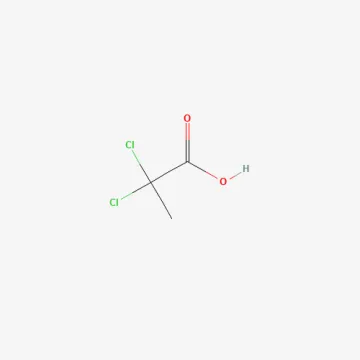
Dalapon
Description
Mode of action
Dalapon belongs to the class of alkanecarboxylic acid herbicides and acts as a selective systemic herbicide.
The active ingredient is readily absorbed by both roots and leaves, subsequently translocating throughout the plant's vascular system to the growing points.
Its primary mode of action involves interfering with the production of pantothenic acid, which is critical for cell division and plant enzyme function.
Upon application, weed growth ceases rapidly, followed by chlorosis, stunting, and eventually total necrosis of the treated grass weeds.
In soil, the compound is degraded primarily by microbial activity, with the rate of dissipation being highly dependent on soil moisture and temperature conditions.
What it targets
This herbicide is specifically designed to control a wide range of annual and perennial grass weeds in agricultural settings.
Key targets include couch grass (Elymus repens), green foxtail, barnyard grass, and other stubborn graminaceous weeds.
It is commonly utilized in fields planted with sugar beets and fodder beets to maintain weed-free crop rows during the early stages.
It is also employed for pre-planting site preparation for potatoes and other vegetable crops that are highly susceptible to competition.
The herbicide has little to no effect on broadleaf weeds, necessitating the use of combination herbicides for comprehensive field protection.
Rates and timing
Application rates depend significantly on the weed species present, the stage of weed development, and the environmental context.
For deep-rooted perennial grasses like couch grass, higher application rates are typically required to effectively eradicate the rhizome network.
The most effective results are achieved when weeds are treated during their active growth phase, generally between the two-leaf and four-leaf stages.
Timing must be carefully aligned with the growth stage of the crop to ensure that the herbicide is used without causing phytotoxic damage.
Always ensure consistent agitation of the spray tank to keep the herbicide uniformly dispersed throughout the liquid application process.
Restrictions
A primary concern with this chemical is the potential for residual effects, which must be monitored if rotating sensitive crops in the following season.
Avoid applying the herbicide during extreme weather conditions such as high temperatures or drought, which can compromise systemic absorption.
Strict adherence to personal protective equipment requirements is mandatory for operators to prevent skin, eye, and respiratory exposure during mixing and spraying.
Drift management is essential; avoid spraying during windy conditions to prevent the herbicide from damaging adjacent crops or sensitive vegetation.
Storage of the chemical should be restricted to secure, ventilated areas to maintain efficacy and ensure the safety of farm personnel and the environment.
Status in the European Union
Not approved in the EU
- CAS number
- 75-99-0
- Category (EU)
- HB - Herbicide
EU status is for reference only and does not replace national registration in your country.