
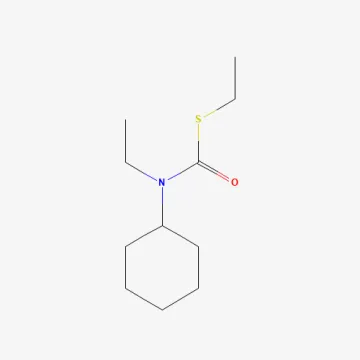
Cycloate
Description
Mode of action
Cycloate belongs to the chemical class of thiocarbamates. It is a selective herbicide that inhibits the growth and cell division in the meristematic tissues of susceptible plants.
The active ingredient is primarily absorbed by the shoots of weeds during their germination through the soil layer. The substance blocks lipid synthesis, which leads to the disruption of cuticle formation and cessation of sprout development.
A crucial aspect is its systemic action aimed at inhibiting the germination of weed seeds. The compound disrupts the metabolic processes responsible for the formation of the root system and the subsequent growth of the weed's aerial part.
The activity of the substance depends directly on soil moisture and the quality of pre-sowing soil preparation. Correct application ensures the creation of a protective barrier that prevents the emergence of the first wave of weeds.
In the soil, cycloate gradually undergoes microbial degradation, which eliminates long-term residual effects on subsequent crops in the rotation if regulations are followed.
What it targets
Cycloate is primarily used for controlling annual grasses and some broad-leaved weeds. It shows high efficacy against barnyard grass, foxtails, and other early-season grass species.
The use of this product is critical for protecting sugar beet and fodder beet crops. Cultivated plants exhibit high physiological resistance to it, allowing application during the sowing period.
- Barnyard grass (Echinochloa crus-galli)
- Yellow foxtail (Setaria glauca)
- Green foxtail (Setaria viridis)
- Common lambsquarters (Chenopodium album)
The herbicide works best against seeds in the germination stage and is ineffective against well-established perennial weeds with powerful rhizomes.
The effectiveness against broad-leaved weeds can be limited, so it is often applied in tank mixtures with other herbicides to expand the spectrum of action.
Rates and timing
The application rate of the product varies depending on the soil type: heavier clay soils require higher dosages, while light sandy soils require minimal amounts.
The main method of application is pre-plant incorporation into the soil, with immediate mixing required. This is a critical stage, as cycloate is a volatile compound and evaporates rapidly from the soil surface.
Incorporation is usually carried out using soil cultivation equipment, such as cultivators or disc harrows, to a depth of 5 to 10 centimeters.
Optimal timing for treatment is immediately before or during sowing to ensure the maximum concentration of the herbicide in the weed seed germination zone.
Application is not recommended under extremely high air temperatures, as this accelerates the volatilization of the active ingredient and reduces its biological efficacy.
Restrictions
The main limitation is the requirement for immediate soil incorporation. Without mechanical mixing into the top layer of the soil, the product's effectiveness drops to near zero.
Use on soils with very high organic matter content is prohibited, as humus actively adsorbs the substance, reducing its bioavailability for weed sprouts.
It is necessary to strictly follow crop rotation guidelines and storage rules, taking into account the product's chemical properties and environmental hazard class.
When working with cycloate, the use of personal protective equipment for skin, respiratory tract, and eyes is mandatory to prevent toxic exposure.
If the application technology is violated, phytotoxicity to crops may occur, manifesting as temporary growth retardation and yellowing of the leaves.
Status in the European Union
Not approved in the EU
- CAS number
- 1134-23-2
- Category (EU)
- HB - Herbicide
EU status is for reference only and does not replace national registration in your country.