
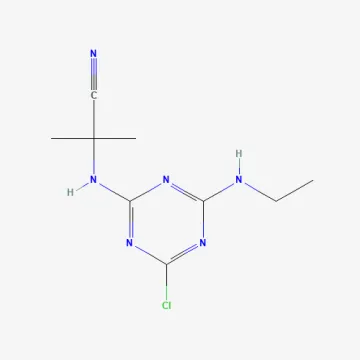
Cyanazine
Description
Mode of action
Cyanazine belongs to the class of symmetric triazine herbicides, which are widely recognized for their effective role in controlling undesirable vegetation in agricultural systems.
The primary mechanism of action involves the inhibition of photosynthesis within target plants, specifically targeting the electron transport process in photosystem II.
By preventing the conversion of light energy into chemical energy, the substance effectively starves the weed, leading to chlorosis, tissue necrosis, and eventual plant death.
Selectivity for crop plants is maintained through the plant's metabolic capacity to break down the herbicide into harmless compounds, provided the dosage is applied correctly.
The substance is primarily absorbed through the root system, emphasizing the importance of soil moisture for the uptake and transport of the herbicide to the foliage of weeds.
What it targets
Herbicides of this group are typically used for the control of a broad spectrum of annual broadleaf weeds and certain grass species in various row crops.
Commonly targeted weeds include species such as pigweed, lambsquarters, smartweed, and various cruciferous weeds that compete with the main crop during early growth stages.
The application is aimed at creating a residual barrier in the soil, which helps to suppress weed germination over an extended period of time following the initial treatment.
The effectiveness of this group is generally low against deep-rooted perennial weeds, which are better managed through alternative or integrated control strategies.
The level of weed control is highly dependent on the susceptibility of the weed population, as some regional biotypes may have developed resistance over years of chemical pressure.
Rates and timing
Application timing varies depending on the crop management system, ranging from pre-emergence soil treatments to early post-emergence applications on the growing crop.
Dosage rates are determined by soil texture and organic matter content, as higher organic matter binds more of the active ingredient, requiring adjustments in concentration.
Proper soil preparation is crucial; a fine, level seedbed facilitates uniform distribution of the herbicide and ensures consistent performance across the entire treated field.
Water volume should be adequate to ensure uniform coverage, especially when applying as a foliar treatment to target young, actively growing weeds.
Consistent sprayer calibration is necessary to ensure that the label-recommended dosage is applied accurately to prevent either crop damage or insufficient weed control.
Restrictions
Strict attention must be paid to crop rotation restrictions, as residues of this herbicide group may persist in the soil and affect subsequent sensitive crop species.
Application on very light, sandy soils should be avoided or carefully restricted due to the high risk of leaching into groundwater and potential phytotoxicity to the crop.
Operators must adhere to all safety protocols, including the use of protective clothing and respirators, to prevent exposure to the active ingredients during mixing and loading.
Environmental precautions must be taken to prevent spray drift toward neighboring fields, sensitive crops, or water bodies where aquatic life could be negatively impacted.
Storage of these chemicals requires secure, climate-controlled facilities to maintain product integrity and prevent accidental spills or contamination of the surrounding area.
Status in the European Union
Not approved in the EU
- CAS number
- 21725-46-2
- Category (EU)
- HB - Herbicide
EU status is for reference only and does not replace national registration in your country.