
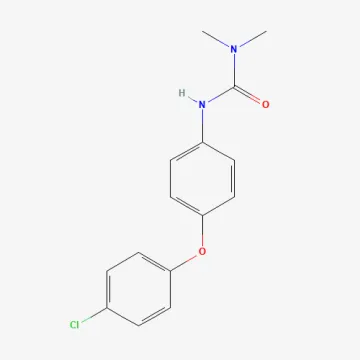
Chloroxuron
Description
Mode of action
Chloroxuron belongs to the chemical class of urea derivatives (phenylureas). It is a selective herbicide that primarily affects photosynthesis processes within the cells of susceptible plants.
Upon entering the plant system, the active ingredient inhibits the Hill reaction. This leads to a blockage of electron transport during the light-dependent phase of photosynthesis, effectively halting the energy production required for weed growth and survival.
The product exhibits significant soil activity but can also penetrate through the leaf tissue of weeds. It shows moderate persistence in the soil, creating a protective barrier to control emerging weeds.
Maximum efficacy is achieved when the product is applied during the early stages of weed development, specifically when weeds are in the cotyledon or early true-leaf stage.
Due to metabolic specificities, crop plants are often able to detoxify chloroxuron, ensuring the selectivity of the herbicide and allowing for post-emergence applications over cultivated fields.
What it targets
Chloroxuron is designed to control a broad spectrum of annual broad-leaved weeds and some grass species. It effectively suppresses common species such as common lambsquarters, knotweed, shepherd's purse, and common chickweed.
This herbicide is most commonly used in strawberries, as well as various vegetable crops and ornamental plantings. It is essential in protection programs where weed eradication is required without damaging the primary crop.
The spectrum of action includes:
- Knotweed species (Polygonum spp.)
- Common lambsquarters (Chenopodium album)
- Shepherd's purse (Capsella bursa-pastoris)
- Common chickweed (Stellaria media)
- Hemp-nettle (Galeopsis tetrahit)
It is important to note that chloroxuron has limited effectiveness against perennial weeds with well-developed root systems, such as thistles or couch grass.
To broaden the spectrum of action and enhance the control of resistant grasses, chloroxuron is frequently used in tank mixtures with other herbicides to achieve a comprehensive effect.
Rates and timing
Application rates for chloroxuron directly depend on soil type, weed density, and the species composition of the weeds. On light soils with low organic matter content, dosages are typically reduced to avoid phytotoxicity.
Applying the product requires strict adherence to timing. In strawberries, it is recommended to apply it after transplanting or in early spring when weeds are in a vulnerable developmental stage.
The spray solution must be distributed evenly across the treated area. It is crucial to avoid drift onto sensitive neighboring crops, as the substance possesses high biological activity.
The frequency of applications per season is strictly regulated by safety guidelines. It is recommended to maintain intervals between applications to prevent the accumulation of residues in the final product.
To increase efficacy, it is recommended to perform applications under conditions of adequate soil moisture, which facilitates better uptake of the substance by the weeds' root systems.
Restrictions
Chloroxuron is a moderately hazardous compound. When working with it, personal protective equipment (gloves, respirators, protective clothing) must be used to prevent skin and mucous membrane contact.
Special caution should be exercised in the presence of crop plants sensitive to urea derivatives. Do not apply during high wind conditions to prevent spray drift.
After field operations, access for people and animals should be restricted for the established waiting period. This is necessary to prevent contact with the treated surface.
It is prohibited to discharge product residues into water bodies or drainage systems. Chloroxuron is ecotoxic to aquatic organisms, so water protection zones must be strictly observed.
Store the herbicide in its original packaging in a cool, dry place out of reach of children and away from food products. Upon expiration, the product must be disposed of according to local regulations.
Status in the European Union
Not approved in the EU
- CAS number
- 1982-47-4
- Category (EU)
- HB - Herbicide
EU status is for reference only and does not replace national registration in your country.