
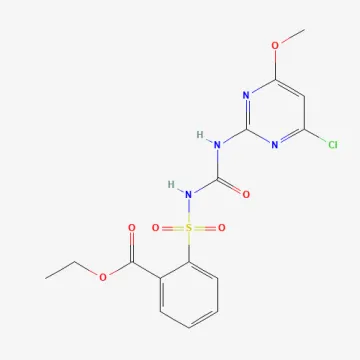
Chlorimuron-ethyl
Description
Mode of action
Chlorimuron-ethyl belongs to the sulfonylurea chemical class. It is a systemic herbicide that is rapidly absorbed by the leaves and root system of weeds, then actively translocated through the xylem and phloem to the meristematic tissues.
The primary mechanism of action involves the inhibition of the acetolactate synthase (ALS) enzyme. Suppression of this enzyme results in the immediate cessation of cell division and stops the growth of susceptible weed species.
Initial visual symptoms of damage, such as chlorosis and necrosis of growing points, appear within a few days after application. Complete plant death occurs within 1–3 weeks, depending on weather conditions and weed growth stages.
The substance possesses significant residual soil activity, which allows it to suppress successive flushes of germinating weeds for a period following application.
Due to its high selectivity, crop plants, particularly soybeans, are capable of metabolizing the compound into non-toxic components, providing a high safety profile for the target crop when used according to regulations.
What it targets
The active ingredient is effective against a wide range of broad-leaved weeds. It shows high efficacy against difficult-to-control species such as common ragweed, pigweed, velvetleaf, knotweeds, and several cruciferous weeds.
Chlorimuron-ethyl is primarily utilized in soybean fields as a reliable tool for managing weeds that compete for moisture, sunlight, and essential nutrients.
Rates and timing
Application rates depend on the weed spectrum, their developmental stage, and soil type. Treatment is typically performed when weeds are actively growing, ideally from the cotyledon stage up to the 2–4 true leaf stage.
A crucial success factor is the inclusion of surfactants in the tank mix. This significantly improves the herbicide's penetration through the leaf cuticle, especially under dry conditions or when weeds exhibit thick wax layers.
Optimal temperatures for application range from +10°C to +25°C. Avoid spraying if frost is expected or during extreme heat, as these conditions reduce the overall effectiveness of the treatment.
Restrictions
A key characteristic of sulfonylureas is their residual presence in the soil. Chlorimuron-ethyl has a long half-life, which imposes strict limitations on crop rotation.
When planning subsequent crops, it is vital to consider soil pH levels and cumulative rainfall. Under cold or acidic soil conditions, the degradation process is slowed, which may cause phytotoxicity to follow-up crops.
It is not recommended to apply the product on soils with high organic matter content or extreme pH levels, as this affects the stability of the active ingredient and its availability.
Always conduct a thorough cleaning of the sprayer after application, using specialized cleaning agents to prevent damage to sensitive crops in subsequent spraying operations.
Application during high winds is strictly prohibited to prevent drift onto neighboring fields containing sensitive agricultural crops or native vegetation.
Status in the European Union
Not approved in the EU
- Category (EU)
- HB - Herbicide
EU status is for reference only and does not replace national registration in your country.