
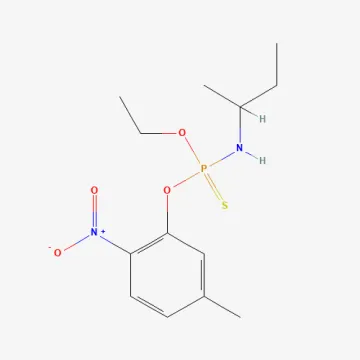
Butamifos
Description
Mode of action
Butamifos belongs to the chemical class of organophosphate compounds, which possess significant herbicidal activity. Unlike some other classes of pesticides, butamifos exhibits selective effects, primarily targeting the suppression of weed seedlings during the critical stages of their development.
The mechanism of action of the substance is based on the inhibition of cell division processes in the meristematic tissues of the seedlings. Upon entering the soil, the active component blocks key enzymatic reactions necessary for the synthesis of nucleic acids and proteins, which leads to the cessation of root and seedling growth.
The preparation affects weeds at the seed germination stage. Due to its systemic effect through the soil, butamifos effectively suppresses the weed potential even before they emerge above the soil surface, providing the crop with a growth advantage during the initial stages of vegetation.
The efficacy of the preparation directly depends on soil moisture and the presence of organic matter. Under optimal agricultural conditions, the active substance is evenly distributed in the top horizon, creating a protective screen that hinders the development of unwanted vegetation.
This substance possesses sufficient soil stability, which allows it to suppress secondary flushes of weeds for a certain period. This makes it a valuable component of integrated crop protection programs against grasses and some broad-leaved species.
What it targets
The primary purpose of butamifos is the control of annual grass weeds in crop fields. It demonstrates high selectivity, targeting specific species that create competition for nutrients and moisture at an early stage.
The spectrum of action includes a wide range of grass weeds, such as barnyard grass, various foxtail species, and other problematic representatives of the flora that infest fields. The preparation works effectively under conditions of moderate infestation, ensuring clean crops.
Application of the preparation is most relevant for vegetable crops, such as tomatoes and peppers, as well as in rice cultivation. Using butamifos allows for a reduction in manual labor costs for weeding and optimizes the planting density of crop plants.
An important aspect is that butamifos does not suppress actively growing weeds, as it does not possess pronounced foliar herbicidal properties. Its biological target is specifically seeds in the germination phase and shoots before they break the soil surface.
The preparation works perfectly in combination with other crop protection products when it is necessary to expand the spectrum of action against broad-leaved weed species. This allows for the creation of tank mixtures that ensure integrated crop protection during the early critical period.
Rates and timing
Application rates of butamifos vary depending on soil type, its mechanical composition, and the predicted level of weed infestation in the field. It is recommended to strictly follow the regulations specified by the manufacturer for the specific crop to avoid phytotoxicity.
The timing of the preparation application is usually tied to the sowing or transplanting period. Often, the optimal moment is incorporation directly into the soil before mulching or immediately after planting, before weed shoots appear above the surface.
Uniformity of the working solution distribution is the key to successful weed control. Thorough soil preparation is necessary — it should be finely cloddy, without large lumps, to ensure high-quality contact of the active substance with weed seeds.
To achieve maximum biological efficiency, one should consider the temperature regime and soil moisture level. In dry conditions, the effect of the preparation may weaken, which requires irrigation or adjustment of the application timing to activate the herbicidal screen.
- Checking the functionality of spraying equipment.
- Calibration of nozzles for even coverage.
- Adherence to the regulated dosage per hectare.
- Control of the incorporation depth if provided by the technology.
Restrictions
When using butamifos, it is necessary to follow safety measures characteristic of working with organophosphate pesticides. Work must be carried out using personal protective equipment to prevent contact of the preparation with the skin and mucous membranes.
Drift of the working solution onto neighboring crops that may be sensitive to the herbicide's action is not allowed. When spraying, one should consider the wind direction and speed to avoid the aerosol escaping the treated area.
It is important to observe sanitary norms when preparing the working solution. It is forbidden to use containers from pesticides for household needs or animal feed preparation, as well as to discharge residues of the preparation into open water bodies or drainage systems.
Storage of butamifos requires specialized conditions — storage facilities must be dry, ventilated, and protected from direct sunlight. The temperature range for storage must meet safety requirements that exclude degradation of the chemical composition.
After finishing work with the preparation, thorough cleaning of the equipment using neutralizing agents is required. Disposal of empty containers must be carried out in accordance with current environmental legislation, which prevents environmental pollution.
Status in the European Union
Not approved in the EU
- CAS number
- 36335-67-8
- Category (EU)
- HB - Herbicide
EU status is for reference only and does not replace national registration in your country.