
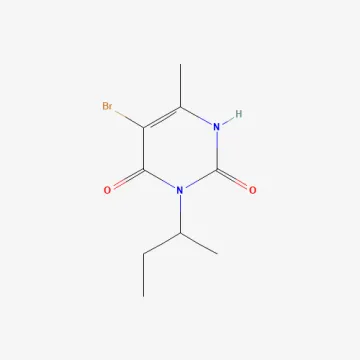
Bromacil
Description
Mode of action
Bromacil belongs to the chemical class of uracil derivatives. It is a systemic herbicide primarily absorbed by the plant root system from the soil solution.
Upon absorption, the active ingredient translocates through the xylem to the growing points and leaves. It acts by blocking photosynthesis, specifically disrupting electron transport in photosystem II.
As a result of inhibiting light-dependent reactions, the synthesis of essential organic compounds ceases within the weed tissues.
Gradually, toxic metabolic products accumulate in the plant, causing chlorosis, necrosis, and the subsequent death of the entire vegetative mass.
The product exhibits high residual soil activity, providing a long-lasting protective effect and control against subsequent weed emergence.
What it targets
This substance is effective against a broad spectrum of annual and perennial grasses and broad-leaved weeds.
It is particularly significant for its ability to control rhizomatous and creeping perennial species that are difficult to manage by other means.
It is widely used for weed control on non-agricultural sites, such as industrial areas, railway tracks, and airport runways.
In agriculture, it is utilized in specific crops, such as citrus orchards and pineapple plantations, where long-term weed suppression is required.
The substance has virtually no selectivity, meaning its use in sensitive crops is strictly prohibited due to the risk of complete crop loss.
Rates and timing
Bromacil application rates vary from 2 to 15 kg of active ingredient per hectare, depending on the management goals and soil type.
For maximum effectiveness, application should be conducted before the start of the active growth season or immediately after rainfall.
In light sandy soils, dosages must be reduced, as high substance mobility can cause damage to sensitive crops through leaching into the root zone.
The period of residual activity ranges from 6 to 12 months, which is attributed to the substance's high stability against degradation in the soil profile.
Soil moisture is a critical factor, as it is necessary for the activation of the herbicide and its movement to the weed root systems.
Restrictions
Bromacil is characterized by high persistence, which limits crop rotation on treated areas for a period of up to several years.
Spray drift must be strictly avoided to prevent damage to neighboring agricultural land, shelterbelts, and aquatic environments due to its high phytotoxicity.
When handling the product, the use of personal protective equipment for skin, respiratory, and eye protection is mandatory to prevent exposure.
The use of the product in water protection zones is prohibited, as the substance can easily migrate into groundwater under excessive moisture conditions.
Equipment must be thoroughly cleaned with appropriate solutions after use to avoid cross-contamination when applying other products to different crops.
Status in the European Union
Not approved in the EU
- CAS number
- 314-40-9
- Category (EU)
- HB - Herbicide
EU status is for reference only and does not replace national registration in your country.