
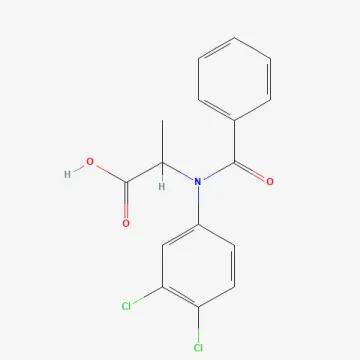
Benzoylprop
Description
Mode of action
Benzoylprop and its derivatives, particularly benzoylprop-ethyl, belong to the chemical class of aminopropionic acid derivatives. These are selective systemic herbicides designed for the control of annual grass weeds.
The mechanism of action of this group is based on inhibiting the growth process of plant meristematic tissues. Once applied to the leaf, the active substance is actively absorbed and transported to growth points, causing irreversible disruptions in cell division.
Unlike many other herbicides, benzoylprop does not cause immediate weed death but leads to a gradual cessation of vegetation. In the first days after application, weed growth stops, followed by symptoms of chlorosis and necrosis.
For the herbicidal effect to be activated, the product must penetrate directly into the leaf surface of the weed. It is essential to ensure high-quality coverage of the leaf area during the spraying process.
The active substance has specific selectivity, allowing the protected crop to continue active growth even with a high degree of grass weed infestation in the field.
What it targets
The primary target for this group of substances is wild oat (Avena fatua). This is a persistent weed that causes significant damage to cereal crop yields.
The products effectively work against a wide range of wild oat populations, including those that show resistance to other types of herbicides.
The use of benzoylprop is justified in cereal crops where high selectivity is required to avoid damaging the main plant.
Herbicides of this group do not have significant activity against broad-leaved weeds, so they are often used in tank mixtures to provide comprehensive protection.
The effectiveness of the impact directly depends on the developmental stage of the wild oat; weeds are most sensitive in the early phases of growth, up to the tillering stage.
Rates and timing
Application timing is determined by the phenological stage of weed development. The optimal period is when the wild oat is in the two to four true leaf stage.
Application at later stages significantly reduces biological efficiency because the weed manages to develop a powerful root system and resistance to the herbicide.
The application rate of the working solution should be sufficient for complete wetting of the vegetative mass, which typically ranges from 200–300 liters per hectare for ground spraying.
The temperature regime during treatment plays an important role: the most active absorption occurs at air temperatures between +12 and +22 degrees Celsius.
It is not recommended to carry out treatment if there is a threat of precipitation in the next 4–6 hours, as this may lead to the product being washed off the leaf surface.
Restrictions
Products based on benzoylprop require strict adherence to usage regulations to avoid phytotoxicity to cultivated plants.
When working with chemicals, it is necessary to use personal protective equipment, including respirators, gloves, and protective coveralls, to prevent the substance from coming into contact with skin and mucous membranes.
Avoid spray drift onto neighboring fields with sensitive crops, as the substance possesses high biological activity.
Spraying is prohibited in windy weather, when wind speeds exceed 5 meters per second, due to the high risk of damage to adjacent areas.
After work is completed, equipment must be thoroughly washed with special cleaning agents to prevent residual effects on other crops during subsequent treatments.
Status in the European Union
Not approved in the EU
- Category (EU)
- HB - Herbicide
EU status is for reference only and does not replace national registration in your country.