
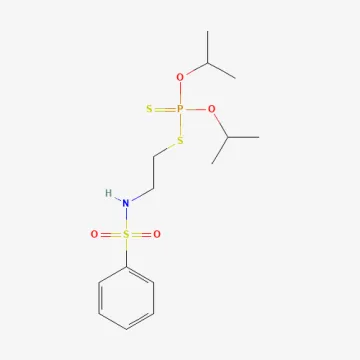
Bensulide
Description
Mode of action
Bensulide is a specialized organophosphate compound that functions primarily as a selective herbicide. Unlike most substances in its chemical class, which are designed for insect control, bensulide targets the growth processes of germinating weed seeds.
The mode of action involves the inhibition of cell division in the meristematic tissues of developing seedlings. By disrupting mitosis, the compound effectively prevents the formation of primary roots and coleoptiles, causing the weed to perish shortly after germination.
The substance acts exclusively as a pre-emergence herbicide. It must be present in the soil zone where weed seeds are actively germinating to intercept the emerging radicals before they establish a root system.
Bensulide exhibits strong adsorption to soil particles, which ensures it remains in the upper soil layers. This persistence provides a protective barrier that suppresses weed emergence over an extended duration depending on soil moisture levels.
Crop selectivity is achieved through metabolic pathways within the protected plants, which deactivate the herbicide before it can interfere with their biological processes. This allows for safe usage in various sensitive horticultural crops.
What it targets
The primary target organisms for bensulide include a wide range of annual grasses and specific broadleaf weeds. Key weeds controlled by this substance are crabgrass, annual bluegrass, and various foxtail species.
It is extensively used in professional turf management and vegetable crop production, where selective weed control is essential to ensure that crops or desirable grass species can establish themselves without early-season competition.
Rates and timing
Application rates are strictly determined by soil type and the expected weed pressure. Soils with higher organic matter content typically necessitate higher doses to compensate for the herbicide's binding to organic colloids.
Timing is critical; the product should be applied prior to the emergence of both weeds and the crop. Post-emergence application is largely ineffective because the chemical cannot move systemically through the foliage of established plants.
Restrictions
Successful application requires either mechanical incorporation into the soil or irrigation shortly after treatment. This activation step is vital to move the herbicide into the root zone and minimize loss due to volatility or photolysis.
As an organophosphate, strict adherence to safety protocols is mandatory. Operators must utilize appropriate personal protective equipment, including chemical-resistant gloves and respiratory protection, to prevent accidental exposure during mixing and application.
Status in the European Union
Not approved in the EU
- CAS number
- 741-58-2
- Category (EU)
- HB - Herbicide
EU status is for reference only and does not replace national registration in your country.