
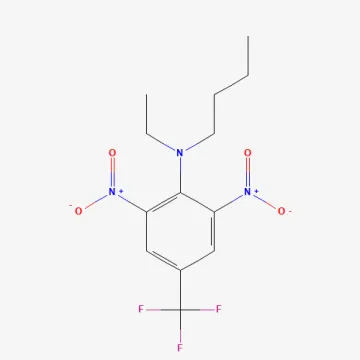
Benfluralin
Description
Mode of action
Benfluralin is a selective pre-plant incorporated herbicide belonging to the dinitroaniline chemical class. It acts as a primary barrier against emerging weeds, specifically targeting germinating seeds.
The primary mechanism of action involves the inhibition of mitosis in the meristematic tissues of weed seedlings. By disrupting the formation of microtubules, the herbicide prevents cell division, causing the seedling to stop growing immediately upon germination.
Unlike systemic herbicides, benfluralin lacks the ability to translocate within established plants. Its activity is strictly limited to the soil zone where it is incorporated, acting as a defensive shield for the crop.
The efficacy of benfluralin is highly dependent on proper soil incorporation. Since the active ingredient has low mobility in soil and is prone to photodegradation, mechanical mixing after application is essential.
Once incorporated, the herbicide maintains its effectiveness in the treated soil layer, providing a residual effect that protects crops during the critical early stages of their establishment.
What it targets
Benfluralin is primarily used to control annual grasses and a selection of broadleaf weeds. Key targets include barnyard grass, foxtails, and crabgrass, which are major competitors in various cropping systems.
Typical crops treated with benfluralin include peanuts, alfalfa, lettuce, and various ornamental nursery stock. It is valued for its ability to protect these sensitive crops from initial weed pressure.
It is important to note that benfluralin is ineffective against established perennial weeds that propagate via rhizomes or tubers, as it only impacts seed germination and initial radical development.
By preventing the emergence of competing grasses, benfluralin helps ensure that the cultural crop has adequate access to nutrients and water, promoting more vigorous initial development.
The spectrum of control can vary based on local soil conditions and the presence of specific weed populations that may have developed resistance in certain regions.
Rates and timing
Application rates for benfluralin are strictly determined by the soil texture and organic matter content. Lighter soils typically require lower application rates compared to heavy clay soils.
The product must be applied as a pre-plant treatment and incorporated into the soil at a depth of approximately 5–10 cm. This process ensures the herbicide creates a uniform barrier for germinating weed seeds.
Timely application is crucial, as the product is meant to be in the soil before the weeds start their germination process. Delaying incorporation can lead to significant loss of active ingredient due to UV exposure.
Precision in application equipment calibration is necessary to achieve a uniform distribution. Avoid overlap or uneven application to prevent potential crop stunting or areas of reduced efficacy.
- Light/Sandy soils: Lower dosage required to prevent leaching or crop injury.
- Heavy/Clay soils: Higher dosage required to maintain adequate concentration in the soil solution.
Restrictions
The most critical limitation is the requirement for immediate soil incorporation. Exposure to sunlight leads to rapid degradation, which significantly reduces the herbicide's effectiveness.
Benfluralin is not recommended for soils with extremely high organic matter levels, as the herbicide particles bind to organic components, reducing their availability for target weed inhibition.
Compliance with crop rotation intervals is mandatory to avoid carry-over effects. Sensitive crops planted too soon after application may exhibit growth inhibition or stunting.
Personal Protective Equipment (PPE) is essential for all handlers. Workers must avoid direct contact with the concentrated product and ensure proper ventilation during mixing and loading.
Environmental precautions are vital; the herbicide must not be applied near aquatic ecosystems, as it is toxic to fish and other aquatic organisms, posing a risk to biodiversity.
Status in the European Union
Not approved in the EU
- CAS number
- 1861-40-1
- Category (EU)
- HB - Herbicide
- Approved from
- 01.03.2009
- Approval until
- 12.02.2023
- ADI
- 0.005 mg/kg bw/day
- ARfD
- 0.5 None
- AOEL
- 0.011 mg/kg bw/day
EU status is for reference only and does not replace national registration in your country.