
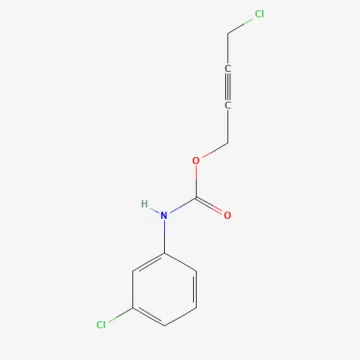
Barban
Description
Mode of action
Barban belongs to the carbamate chemical class and acts as a selective contact herbicide. Its primary function is to inhibit the process of cell division (mitosis) in the meristematic tissues of sensitive plants.
The substance is primarily absorbed by the leaves of weeds during the early stages of their development. Once inside the plant, the active component blocks the normal development of roots and shoots, leading to growth cessation and subsequent weed death.
The effectiveness of the product directly depends on the growth stage of the weed at the time of application. Barban shows maximum activity only when the developmental phases of target objects are strictly followed.
The product has limited systemic action, so the quality of leaf surface coverage with the working solution is of paramount importance. Weather conditions at the time of application also play a critical role in the metabolism of the active ingredient within the weed.
Unlike many modern systemic herbicides, Barban requires precise application onto the vegetative mass, as the soil activity of the product is relatively weak.
What it targets
The main target object for Barban is wild oat (Avena fatua), which poses a serious threat to the yield of cereal crops.
In addition to wild oats, the product can exert a suppressive effect on some other species of annual grasses, although its selectivity is most pronounced against the Avena genus.
Crops on which this substance is applied include spring and winter wheat, barley, sugar beets, flax, and certain legumes.
It is important to note that Barban is ineffective against broad-leaved weeds; therefore, in crop protection practice, tank mixtures with appropriate herbicides are often used.
The spectrum of suppressed weeds is limited to early stages of grass development, making weed control possible only within a narrow time window.
Rates and timing
The use of Barban requires strict adherence to timelines: the optimal time for application is the two-leaf stage of wild oats. If the weed grows past this stage, the effectiveness of the product decreases sharply.
The application rates of the working solution must ensure uniform wetting of the weed vegetation. This usually ranges from 200 to 300 liters per hectare depending on the type of spraying equipment used.
In field conditions, the number of applications is usually limited to once per growing season to avoid phytotoxicity to crop plants.
Temperature conditions during application should be within moderate limits. Excessively hot or cold weather slows down the absorption of the substance and reduces the overall herbicidal effect.
Monitoring the state of crops is mandatory: if the weed has reached the tillering stage, the use of Barban becomes economically unjustifiable.
Restrictions
Working with Barban requires strict adherence to safety regulations, as the substance is toxic to humans and warm-blooded animals. The use of personal protective equipment for skin and respiratory organs is necessary.
Treatments are prohibited during periods of active bee foraging and near water bodies, as carbamates can be toxic to aquatic organisms.
The product must be stored in dry, cool warehouse facilities, inaccessible to unauthorized persons and animals, in its original factory packaging.
When using tank mixtures, it is necessary to conduct a preliminary test for chemical compatibility of the components to avoid precipitation or reduction in effectiveness.
- Use only certified spraying equipment.
- Follow the regulations for the disposal of product residues and empty containers.
- Avoid drift of the working solution onto neighboring sensitive crops.
Status in the European Union
Not approved in the EU
- CAS number
- 101-27-9
- Category (EU)
- HB - Herbicide
EU status is for reference only and does not replace national registration in your country.