
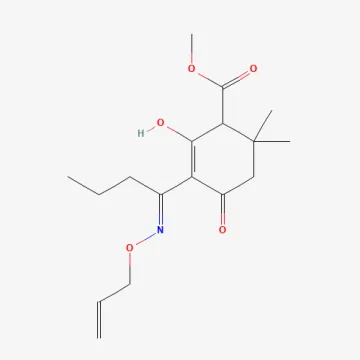
Alloxydim
Description
Mode of action
Alloxydim belongs to the chemical class of cyclohexanedione derivatives. It is a systemic herbicide that is rapidly absorbed by the above-ground parts of weeds and subsequently transported through the phloem to growing points.
The mechanism of action involves inhibiting the enzyme acetyl-CoA carboxylase. This enzyme plays a crucial role in the synthesis of fatty acids, which are essential for building cell membranes.
As a result of blocking lipid synthesis, weed growth stops almost immediately after application. Complete death of sensitive grass species occurs within 1–3 weeks, depending on weather conditions.
The product exhibits high selectivity, allowing it to be used to clean broad-leaved crops from grass vegetation without damaging the main crop.
The effectiveness of Alloxydim is directly dependent on the intensity of metabolic processes in weeds, which is why the fastest results are observed under active growth conditions with sufficient humidity.
What it targets
Alloxydim is used exclusively against a wide range of annual grass weeds. It is effective against species such as wild oats, barnyard grass, foxtail, ryegrass, and other grasses.
It is important to note that the product does not affect broad-leaved weeds or perennial grass crops, which requires the use of tank mixtures if comprehensive protection is needed.
The use of the product is most justified in vegetable, industrial, and forage crops that have high sensitivity to grass competition during early development stages.
The spectrum of action covers weeds in the one- to three- or four-leaf stage. Older plants show increased resistance to the herbicide's effects.
The product is also used on potato, sugar beet, flax, sunflower, and soybean crops to minimize yield losses from annual grass weed infestation.
Rates and timing
Application rates of Alloxydim depend on the species composition of weeds, their infestation level, and the crop's growth stage. Typically, the product is applied to actively growing weeds regardless of the crop's growth stage.
The optimal time for treatment is the period of active weed growth when they are most susceptible to the absorption of active substances. Adherence to timing is critical to prevent secondary regrowth.
It is important to ensure uniform leaf surface coverage during spraying, as the systemic action of the substance requires sufficient contact area with the target plant.
The working solution should be used immediately after preparation. Storing the mixture for more than a day leads to a decrease in the biological activity of Alloxydim.
When planning application timing, meteorological forecasts should be considered: no precipitation for 4–6 hours after application significantly increases the effectiveness of the product.
Restrictions
The use of Alloxydim is prohibited under conditions of stress for crop plants caused by drought, frost, or disease, as this reduces the selectivity of the product.
It is not recommended to cultivate the soil 5–7 days before or after applying the herbicide to ensure the normal distribution of the substance within plant tissues.
When working with the product, individual protection measures must be strictly observed to prevent the concentrate from contacting skin, mucous membranes, and the respiratory tract.
The herbicide should be stored in specialized pesticide warehouses, in tightly closed original packaging, away from food and animal feed.
Residues of the product and wash water must not enter water bodies, as the substance has moderate toxicity to aquatic organisms and requires responsible disposal.
Status in the European Union
Not approved in the EU
- CAS number
- 55634-91-8
- Category (EU)
- HB - Herbicide
EU status is for reference only and does not replace national registration in your country.