
Birch leaf-rolling weevil
Temnocerus nanus
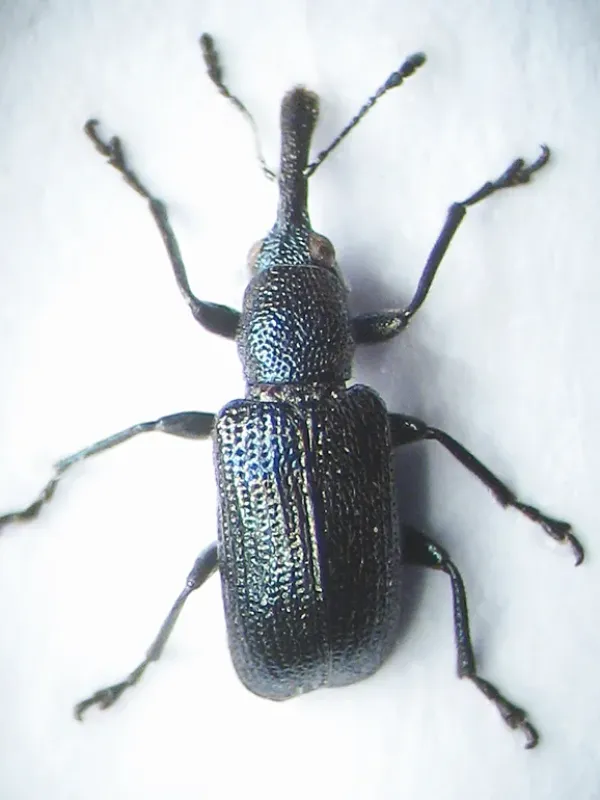
Description
How to identify
The birch leaf-rolling weevil (Temnocerus nanus) belongs to the Rhynchitidae family within the order Coleoptera. This small beetle typically measures between 2 and 3 millimeters in length.
The adult insect displays a metallic sheen, usually in shades of blue, blue-green, or near-black. The elytra are covered with sparse, long, light-colored hairs.
A distinctive feature is the elongated rostrum (snout), which is more pronounced in females, as it is essential for the process of rolling leaves to protect their eggs.
Larvae are characterized by a whitish color, a C-shaped body, and a darkened head capsule. Their cryptic behavior makes them difficult to spot without careful observation.
The entire life cycle of this species is tightly integrated with their host trees, which provide both food and a reproductive environment for the beetles.
##damage##The primary hosts for this weevil are birch species, including silver and downy birch. Occasionally, they may be found on alder or hazel in mixed forest stands.
Damage is caused by both adults and larvae. Adult beetles feed on young leaves, creating small holes that reduce the photosynthetic capacity of the tree canopy.
Larval development occurs within the tightly rolled leaf structures. This feeding activity disrupts nutrient flow and causes the leaf tissue to necrotize and eventually die.
Severe infestations can lead to premature leaf drop, which weakens the host tree, potentially reducing its growth rate and increasing susceptibility to other pathogens.
In landscaping and forestry, high populations of this pest can significantly degrade the aesthetic value and ecological health of birch-dominated stands.
##season##Adult weevils typically emerge from their overwintering sites in late spring, corresponding with the bud burst and early growth of new leaves, usually in May.
The reproductive phase and the period of leaf rolling activity generally persist from late May through mid-July, while the leaves remain soft and pliable.
Larvae complete their development within the rolled leaf tubes before exiting to drop to the soil, where they burrow to pupate until the following spring.
Overwintering occurs primarily in the pupal or young adult stage, located within the leaf litter and topsoil layers beneath the host trees.
The species has a univoltine life cycle, meaning there is only one generation produced per year, which stabilizes its population growth in most environments.
##signs##The most prominent sign of infestation is the presence of neatly rolled leaf structures, often referred to as "cigars," hanging from the branches of the birch tree.
Damaged leaves eventually turn brown and wither prematurely, creating highly visible patches of dead foliage within an otherwise green canopy.
Before leaves are rolled, one may notice small, circular feeding punctures on the foliage, which are indicative of adult beetle activity during the early season.
Inside the rolled leaves, one can often find eggs, larvae, or frass (waste material), which accelerate the breakdown of the leaf structure.
- Rolled, tube-like leaves on birch branches.
- Small, translucent holes in early-season foliage.
- Premature leaf senescence and fall during summer.
Mechanical control, such as collecting and destroying the rolled leaves before the larvae emerge to pupate, is the most effective approach for small-scale infestations.
Cultural practices involve raking and removing leaf litter or tilling the soil beneath susceptible trees in autumn to expose overwintering stages to predation and frost.
In cases of significant population outbreaks, systemic or contact insecticides can be applied during the peak emergence of adults in late spring.
Biological control methods focus on maintaining habitat for insectivorous birds and predatory insects that feed on the adult weevils in the canopy.
Integrated Pest Management (IPM) strategies, including the use of monitoring traps, are recommended to time interventions precisely and reduce chemical usage.
Taxonomy
- Latin name
- Temnocerus nanus
- Order
- Coleoptera (beetles)
- Family
- Attelabidae
- EPPO code
- COENNA
Discussion
No discussions yet — be the first.