
Blue rolling weevil
Temnocerus coeruleus
Description
How to identify
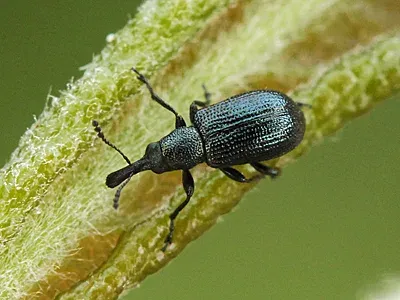
The blue rolling weevil (Temnocerus coeruleus) is a small beetle belonging to the Attelabidae family within the order Coleoptera. Adult specimens are recognizable by their metallic blue or blue-green coloration and a body length of approximately 3 to 5 mm.
The head of the beetle extends into a characteristic snout, which is a hallmark of the weevil group. They possess elbowed antennae and a dense, finely punctured body that stands out against the fresh spring foliage.
The larvae are legless, with a creamy-white, slightly curved body and a distinct brown head capsule. They live a hidden life cycle, feeding exclusively on the tissue of leaves rolled by the adult female.
The pupal stage occurs inside the leaf roll, which provides essential protection from environmental threats and predators. The life cycle is strictly synchronized with the phenology of their host trees.
Adult beetles overwinter in the soil or under leaf litter in the orchard, emerging as soon as tree sap begins to circulate and buds start to burst in the spring.
##damage##The primary hosts of the blue rolling weevil include members of the Rosaceae family, such as apple, pear, cherry, and plum trees. Both adults and larvae contribute to significant agricultural damage, requiring integrated management.
In spring, adults chew holes in young leaves, buds, and fruit ovaries. This feeding activity leads to severe deformation, desiccation, and premature drop of plant parts, weakening the tree's health.
The larvae cause the most significant damage by developing inside tightly rolled leaves. The female beetle cuts the leaf petiole and rolls the leaf into a "cigar" shape, creating a protected environment for her offspring.
The rolled leaves quickly wilt, turn black, and drop to the ground. This drastically reduces the tree's photosynthetic capacity, which is vital for fruit development and storage of energy for winter.
Mass infestations on young nursery stock or seedlings can lead to extensive defoliation, which severely stunts tree growth and reduces their tolerance to winter frost.
When it appears
Adult weevils emerge from hibernation in early spring when temperatures are high enough to support their metabolic activity. This timing coincides with the green-tip stage of host fruit trees.
Peak activity for adults occurs throughout May and June, during which time they feed extensively and lay eggs. These months are the most critical time for monitoring and early detection.
Larval development inside the leaf rolls lasts several weeks. Once development is complete, the larvae drop to the ground to pupate in the soil.
Typically, there is one generation per year; however, in regions with long, warm summers, a partial second generation may occur, increasing the pest pressure on the orchard.
By late summer and autumn, the new generation of adults migrates into the soil to a depth of several centimeters to enter diapause, where they wait for the next spring season.
Signs of infestation
The most distinctive sign of infestation is the presence of neatly rolled leaves on the branches, which resemble small cigars. These rolls often hang from the tree until they eventually dry out and fall.
Leaves inside these rolls lose their turgor, turn brown, and die. Upon unwrapping a leaf roll, one can easily observe the larva or the presence of frass (excrement) left behind by the feeding insect.
On nearby leaves, one can often find irregular feeding holes or notches, which are the result of adult weevils feeding after they emerge from hibernation.
Orchard floors under infested trees often become littered with fallen, rolled leaves, which serve as a source of re-infestation if not properly managed or cleared away.
- Malformed or unopened flower buds that drop prematurely.
- Stunted growth of apical shoots due to localized damage by adults.
Control measures
The most effective mechanical control method is the regular collection and disposal of fallen or hanging leaf rolls before the larvae have a chance to migrate into the soil.
Hand-picking adults in the early morning hours, when they are sluggish and less likely to fly, is highly effective for smaller orchards or home gardens.
Chemical insecticides should be applied during the early adult activity phase, before the leaves are rolled, as the larvae are well-protected once they are inside the "cigar" structures.
Cultivating the soil in tree basins during autumn or early spring can disrupt the pupation sites and expose overwintering beetles to cold temperatures and natural predators.
Biological control methods include encouraging natural bird populations and promoting beneficial entomophagous insects, which help suppress the weevil population without the need for intensive chemical applications.
Taxonomy
- Latin name
- Temnocerus coeruleus
- Order
- Coleoptera (beetles)
- Family
- Attelabidae
- EPPO code
- COENTO
Discussion
No discussions yet — be the first.